
Automate Document Workflows: A Practical Guide for SMEs
Automate Document Workflows: A Practical Guide for SMEs
Why document work still eats your weekAsk any small business owner in Lleida or Tarragona where the hours go and the answer is rarely the work itself....
Why document work still eats your week
Ask any small business owner in Lleida or Tarragona where the hours go and the answer is rarely the work itself. It is the paperwork around it: invoices arriving by email, delivery notes photographed on a phone, contracts filed in a shared drive nobody quite trusts, supplier details retyped into an ERP that does not talk to anything else. The document management industry has spent decades perfecting storage and retrieval, yet the real value has always sat one step further on, in what the information inside those documents could actually do for the business.
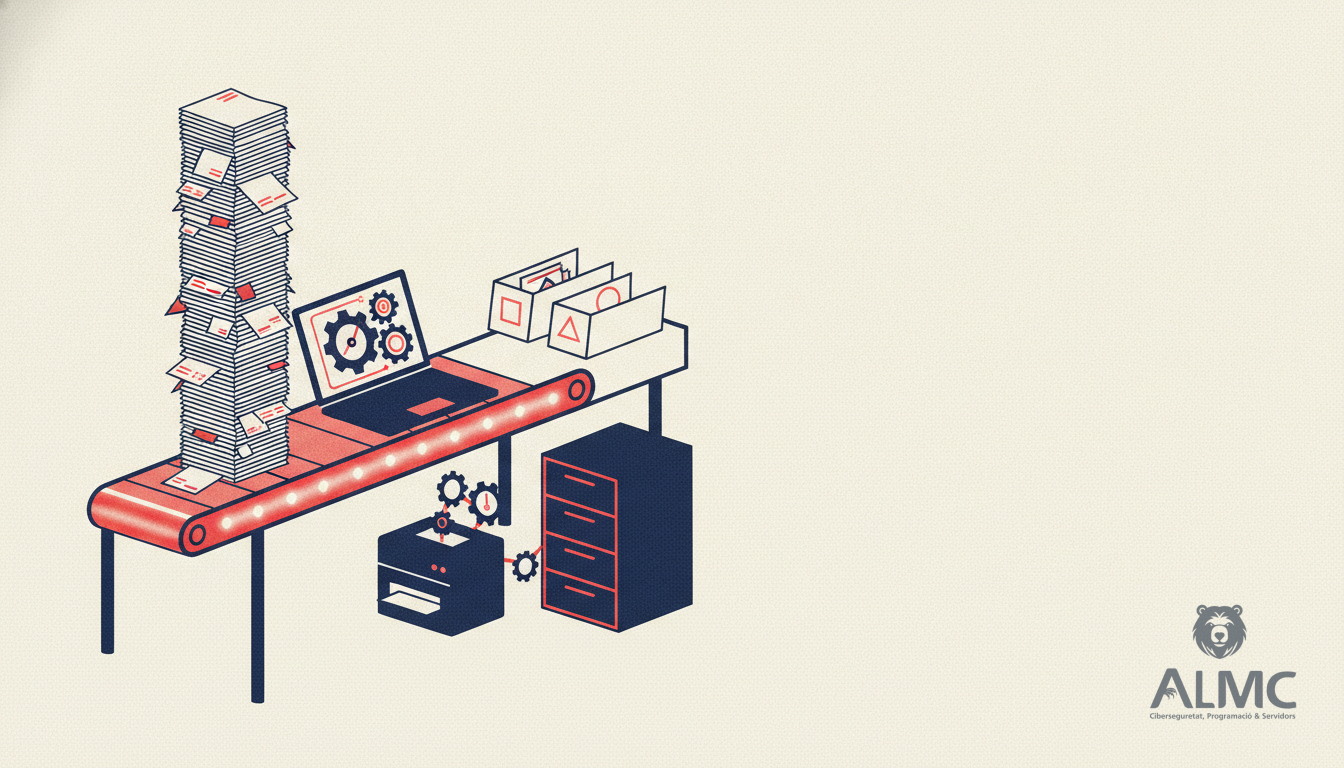
That gap is closing. Modern automation platforms, combined with document intelligence, now let an SME capture a document, read it, classify it, check it against existing records and route it to the right person without anyone lifting a finger. The question for most companies is no longer whether this is possible, but where to start without disrupting the way they already work.
Three layers of automation, one direction of travel
It helps to think of document automation in three layers, each building on the one below.
- Capture and extraction. Optical character recognition has matured to the point where it handles printed text, scanned forms and even handwriting with a high degree of reliability. Add AI-driven extraction and the system can pull out invoice numbers, dates, amounts, VAT breakdowns and supplier names, then reconcile them against your master data so duplicates and mismatches surface immediately.
- Classification and routing. Once content is extracted, documents can be sorted automatically: a purchase invoice goes to accounts payable, a signed contract to the legal folder, a delivery note to logistics. Rules decide who sees what, when and with which permissions.
- Conversational access. The newest layer lets staff ask questions in plain language. Instead of opening five files to check whether a shipping surcharge is covered by a supplier agreement, a finance officer types the question and gets an answer with a reference back to the original clause. It is the difference between searching for information and simply using it.
What this looks like in a Catalan SME
Consider a distribution company near Girona with eight office staff. Before automation, month-end closing meant three people chasing invoices, cross-checking purchase commitments and reconciling bank movements by hand. After connecting their invoicing tool, accounting software and document repository through a workflow platform, the same closing takes a fraction of the time: invoices are captured on arrival, validated against purchase orders, flagged when a line item deviates from the agreed price, and posted to the ledger with the supporting document attached.
The same logic applies to HR, where contracts and payroll documents can be filed and indexed automatically, or to customer service, where a signed service agreement is retrieved in seconds when a client calls. None of this requires replacing the systems a business already runs. It requires connecting them.
Connecting tools beats replacing them
The most common mistake we see is the assumption that automation means buying a new ERP or ripping out existing software. In practice, the opposite is true. Tools such as n8n allow you to build integrations between the applications you already pay for: your CRM, your accounting package, your email, your cloud storage, your e-signature provider. A well-designed workflow listens for an event, such as a new attachment in a shared inbox, extracts what matters, writes it into the right system and notifies the right person.
This approach has three practical advantages for an SME. First, cost: you are extending existing licences rather than adding another platform. Second, adoption: staff keep working in familiar interfaces, so resistance is minimal. Third, compliance: data stays within systems you already control, which matters enormously under GDPR. Any automation that moves personal data between tools must respect the same access rules, retention periods and audit trails as the manual process it replaces, and a well-built workflow makes that easier to prove, not harder.
Where to begin without overcommitting
Start with one process that is repetitive, rule-based and painful. Invoice intake is usually the best candidate, followed by contract filing or lead qualification. Map the steps as they happen today, identify which decisions are genuinely automatic and which need a human, then build the smallest workflow that removes the dullest part.
Measure the result in hours, not in features. If a task that took four hours a week now takes twenty minutes, you have a business case for the next one. From there, automation tends to spread naturally: once staff see that documents arrive classified, validated and ready to act on, they start asking why other processes cannot work the same way.
For SMEs across Catalonia, the opportunity is not about adopting the most advanced technology on the market. It is about removing the friction that has quietly been costing them a day every week, and turning the information already sitting in their documents into something the business can actually use.
Related
- n8n Automation Guide: Streamline Your Business Workflows in 2026
- How Much Does Process Automation Really Cost? A 2026 Guide for SMEs
- Best WordPress SEO Plugins 2026: Expert Comparison for Spanish Sites
- Chatbot IA
Put these ideas into practice
Talk to ALMC about a solution for your business. Explore your options or contact our team.