
Automating Electronic Invoicing: From Certificates to Workflows
Automating Electronic Invoicing: From Certificates to Workflows
Why e-invoicing is really an automation problemWhen Spanish SMEs start preparing for electronic invoicing, the conversation almost always begins with...
Why e-invoicing is really an automation problem
When Spanish SMEs start preparing for electronic invoicing, the conversation almost always begins with certificates. Which one do I need? Where do I get it? That focus is understandable but slightly misplaced: a certificate is only the key that opens the door. The real work — and the real time savings — sit in everything that happens around the signature: generating the file, validating it, sending it to the right recipient, storing the proof and keeping the whole trail auditable.
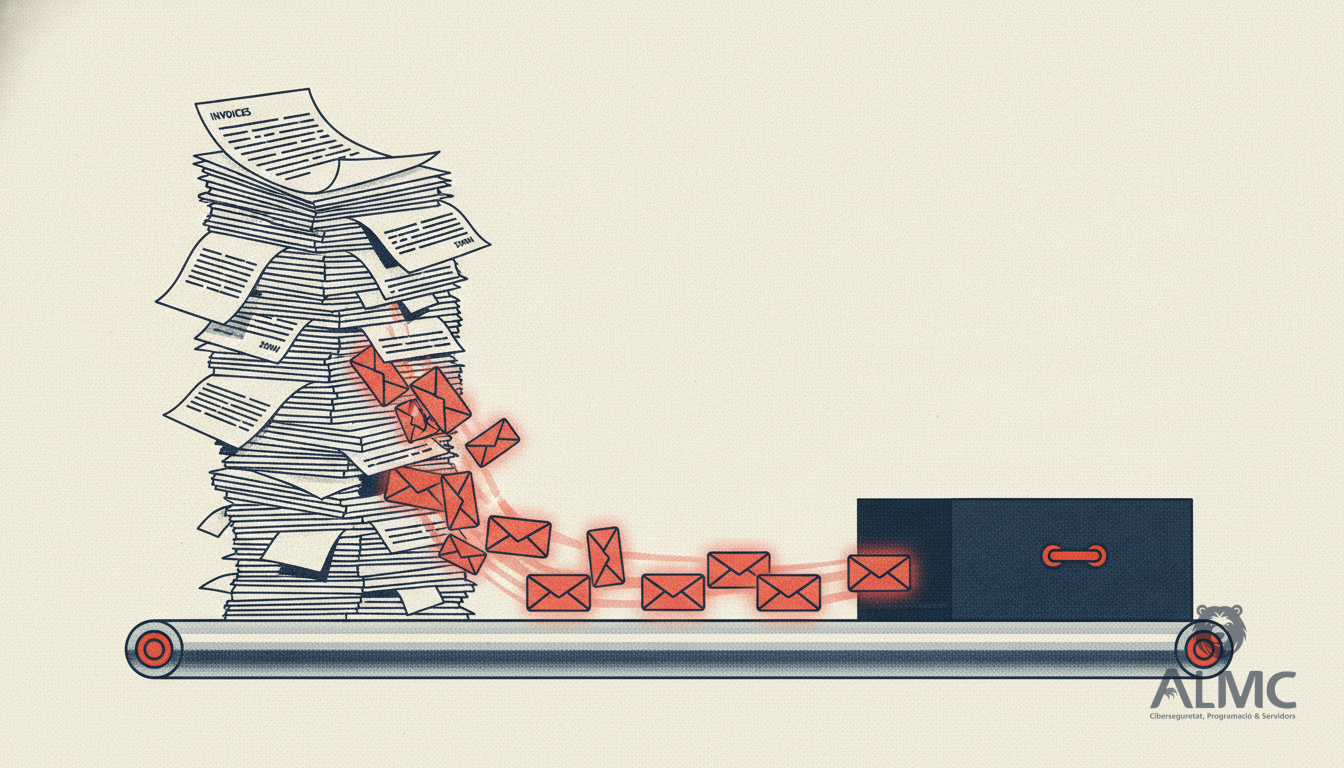
In Catalonia, businesses in Barcelona, Lleida, Tarragona and Girona are already dealing with clients who expect invoices in structured formats and public administrations that only accept them through official entry points. Treating this as a one-off administrative chore leads to manual copy-paste, missed deadlines and folders full of files nobody can trace. Treating it as a process automation project changes the economics entirely.
The certificate is not the invoice
A digital certificate is an electronic document issued by a trusted provider that links a person's identity to cryptographic verification data. In Spain, the Fábrica Nacional de Moneda y Timbre (FNMT) is one of the best-known issuers, and its certificates are widely accepted for signing documents and for dealing with the tax agency and social security systems.
What a certificate does not do is create, send or file your invoice. Those tasks belong to your invoicing software and your delivery channel. Understanding that separation is the first step towards automating the whole chain rather than just the signature.
- Self-employed professionals invoicing under their own NIF typically use an individual certificate, obtainable free of charge and often validated with the electronic ID card.
- Company representatives need a certificate that matches their role: sole or joint administrator, legal-person representative, or representative of an entity without legal personality.
- Invoices to public bodies must be signed with a certificate recognised by the FACe general entry point, and this is where mismatches most often appear.
Most FNMT certificates for individuals and representatives are qualified under the European eIDAS regulation, which gives them cross-border recognition within the EU. That matters if you invoice clients in France, Portugal or beyond.
Where manual invoicing quietly drains your week
Once the certificate works, the repetitive part begins. Someone downloads data from the ERP, builds the Facturae file, checks that the recipient's details are correct, signs, uploads, waits for the acknowledgement and saves the receipt somewhere sensible. Multiply that by dozens or hundreds of invoices per month and you have a task that consumes hours without adding a euro of value — and that is highly prone to human error.
Common failure points we see in local SMEs include expired certificates discovered on the day of submission, invoices rejected because the administration's registry data does not match, and proof of delivery stored in personal mailboxes rather than a shared, traceable location. Each of these is a symptom of a process held together by memory rather than by design.
Designing a connected invoicing workflow
This is exactly the territory where process automation pays for itself quickly. Instead of asking staff to remember steps, you connect the tools you already use so that the steps happen on their own. A typical setup for a small business looks like this:
- Your ERP or accounting platform emits the invoice data automatically at the end of each billing cycle.
- An automation layer — we often build these with n8n, which is open, self-hostable and GDPR-friendly — transforms that data into the required structured format.
- The workflow signs the document with the appropriate certificate, submits it to the correct channel and captures the acknowledgement.
- The signed invoice and its receipt are filed in a shared document repository with consistent naming and access rules.
- Alerts fire when a certificate is close to expiry, when a submission is rejected, or when a client has not received their copy.
Each of those steps is simple. Combined, they remove the manual handoffs where mistakes and delays creep in. The same integrations pattern applies to quotes, delivery notes, expense approvals and payment reminders, which is why invoicing is often the ideal entry point for a broader automation programme.
Compliance and data protection by design
Automation does not replace legal obligations; it makes them easier to meet consistently. Under the GDPR, invoice data is personal data, so any workflow must limit who can access files, log who did what and keep records only as long as necessary. Spanish retention rules for invoicing still apply, which is why a well-structured archive with clear permissions is part of the automation design, not an afterthought.
It also helps to keep the human in the loop where judgement is required: a review step before sending high-value or unusual invoices, for example, can sit inside the automated flow without slowing down the routine ones.
A realistic starting point
You do not need to automate everything at once. Start with the invoice type you issue most often, map the current manual steps honestly, and identify which of them are pure repetition. In our experience with SMEs across Lleida and the rest of Catalonia, a focused first workflow can be live within weeks and typically returns several hours per week to the team — time better spent on clients and growth than on copying reference numbers between screens.
The certificate gets you through the door. Good workflow automation is what keeps the door open, month after month, without anyone having to think about it.
Related
- n8n Automation Guide: Streamline Your Business Workflows in 2026
- How Much Does Process Automation Really Cost? A 2026 Guide for SMEs
- Best WordPress SEO Plugins 2026: Expert Comparison for Spanish Sites
- Chatbot IA
Put these ideas into practice
Talk to ALMC about a solution for your business. Explore your options or contact our team.