
Document Retention in Spain: Automate What You Keep
Document Retention in Spain: Automate What You Keep
Why retention rules matter more than they seemMost SMEs in Catalonia keep everything. Storage is cheap, deleting feels risky, and nobody wants to be t...
Why retention rules matter more than they seem
Most SMEs in Catalonia keep everything. Storage is cheap, deleting feels risky, and nobody wants to be the person who shredded the invoice an inspector later asked for. But keeping everything is not a neutral choice: it costs money, it slows down audits, and under the GDPR it can be a compliance problem in its own right. The principle of storage limitation means personal data should be kept only as long as needed for its purpose, unless a legal obligation justifies keeping it longer.
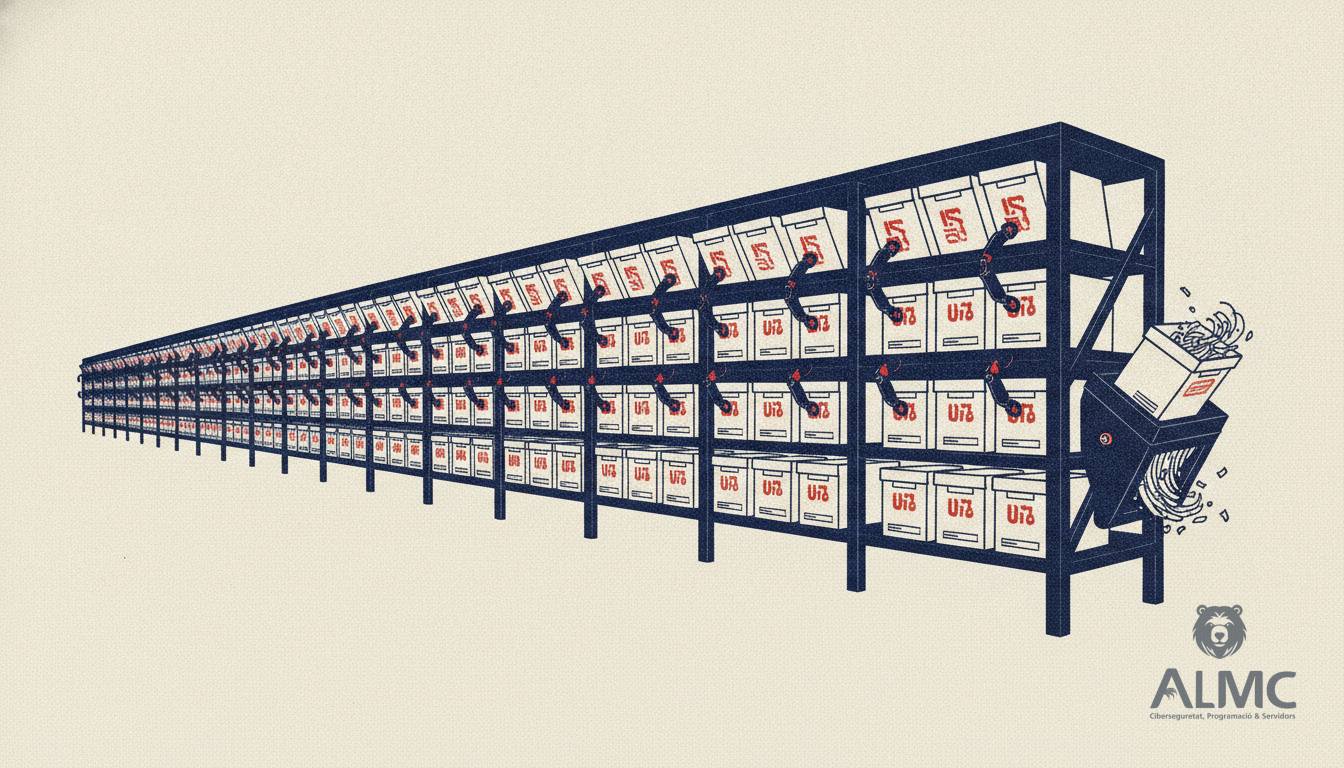
So the real question is not "how long do we keep documents?" but "which rule applies to this document, and who is making sure we follow it?" That second part is where automation earns its keep.
The Spanish framework in brief
There is no single retention period. Several rules overlap and the longest one wins:
- Commercial records. The Code of Commerce requires books, correspondence and supporting documents to be kept for six years, counted from the last entry in the books.
- Tax obligations. The General Tax Law sets a general four-year limitation period for the Administration's rights, but that period can be interrupted, so it is not a green light to delete on day one of year five.
- Invoices. The tax agency applies specific rules, including extended periods for certain acquisitions subject to VAT regularisation and a five-year period for investment gold transactions.
- Social Security. Registration documents must be kept while the person remains registered and for four years afterwards; contribution records and payroll evidence follow a four-year rule.
- Personal data. No fixed period. Data must be reviewed, deleted or blocked once the purpose is fulfilled and no legal duty requires otherwise.
Treat any summary table as orientation, not as an instruction to delete. Before removing anything, check whether an exception applies or whether an inspection or procedure is still open.
Where SMEs actually get stuck
In practice, the difficulty is not reading the rules. It is applying them consistently across a business that generates invoices, payroll records, supplier contracts, CVs, marketing consent records and support tickets every single day. Three failure modes are common in companies around Lleida, Tarragona, Girona and Barcelona:
- Inconsistent filing. The same document type lives in three places under four names, so nobody can prove what is held or for how long.
- Manual calendars. Someone sets a reminder to review an archive folder once a year. It gets postponed, and the folder grows.
- Deletion without evidence. Documents are destroyed, but no record shows when, by whom, or under which policy. That is hard to defend in an audit.
Turning policy into a workflow
A retention policy only works if it is enforced by the systems that hold the documents. That means defining, for each document type, a retention period, a trigger event that starts the clock, an owner, and an action at the end (delete, anonymise or archive). Once those four elements exist, the rest is plumbing.
This is exactly the kind of repetitive, rule-based work that process automation handles well. With a workflow tool such as n8n, you can connect your document management system, invoicing software, HR platform and cloud storage, then let the workflow apply the rules automatically:
- Tag each incoming document with a type and a start date as soon as it is captured.
- Calculate the applicable end date from your policy, not from a person's memory.
- Send a review notification to the document owner before anything is deleted.
- Block deletion automatically when a legal hold, open inspection or pending procedure is flagged.
- Log every action in an immutable register so you can demonstrate compliance.
The result is not just tidier storage. It is a defensible audit trail, faster responses to inspections and a measurable reduction in the hours your team spends hunting for paperwork.
Destroying confidential documents properly
Retention is only half the cycle. When the period ends, confidential material must be destroyed securely, whether on paper or in digital form, and the destruction itself should be documented. For personal data, this ties directly into GDPR accountability: you need to show that data was removed when it should have been. Automating the trigger and the log removes the weakest link, which is usually a busy person remembering to do it.
A practical starting point
Do not try to automate every document category at once. Pick the two or three that generate the most volume, such as supplier invoices and payroll records, document their rules, and build a single workflow for them. Once the pattern works, extend it. For SMEs in Catalonia that want to move faster, this is a service we deliver regularly at ALMC.es: mapping the rules, connecting the tools and leaving a workflow that runs quietly in the background, saving hours every week and keeping your archive under control.
Related
- n8n Automation Guide: Streamline Your Business Workflows in 2026
- How Much Does Process Automation Really Cost? A 2026 Guide for SMEs
- Best WordPress SEO Plugins 2026: Expert Comparison for Spanish Sites
- Chatbot IA
Put these ideas into practice
Talk to ALMC about a solution for your business. Explore your options or contact our team.