
Intelligent Document Management: Automate the Paper Trail
Intelligent Document Management: Automate the Paper Trail
Why your documents are still slowing you downMost SMEs in Lleida, Barcelona or Tarragona have already made the leap to digital files. The problem is r...
Why your documents are still slowing you down
Most SMEs in Lleida, Barcelona or Tarragona have already made the leap to digital files. The problem is rarely the scanner: it is what happens afterwards. A supplier invoice lands in one inbox, a signed contract sits in a shared folder, and the delivery note lives in the ERP. When someone needs to confirm a date or answer a customer, they end up opening three tools and copying data by hand. That is where hours quietly disappear every week.
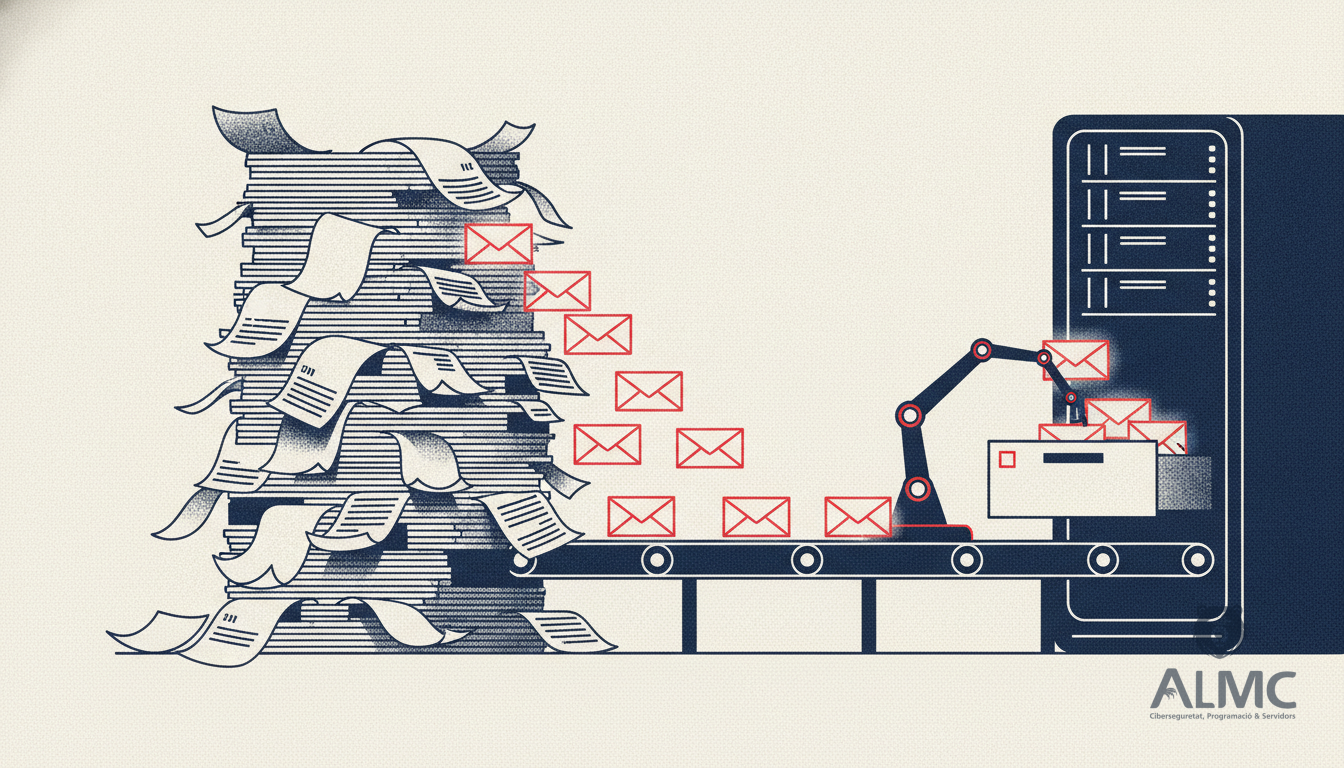
Intelligent document management changes the starting point. Instead of treating files as passive storage, it reads them, understands what they contain and triggers the next step automatically. For a small team, that difference is the gap between chasing paperwork and getting real work done.
What makes document management “intelligent”
A traditional document management system (DMS) organises, protects and preserves files. An intelligent one adds three layers on top:
- Intelligent document processing (IDP): identifies the type of document and extracts key data such as dates, amounts, VAT numbers and supplier names.
- AI-assisted search and summaries: lets you find information without remembering the exact file name or keyword, and condenses long documents into what matters.
- Workflow automation: uses the extracted data to launch tasks, approvals or notifications according to rules you define.
The result is not just a tidier archive. It is a system that understands content and acts on it, which is precisely what separates a simple repository from a genuine productivity tool.
The benefits SMEs notice first
You do not need a large IT department to see the impact. In our projects with Catalan SMEs, the gains tend to appear in the same places:
- Less manual data entry: invoice and form data flows straight into your accounting or ERP system, reducing typos and rework.
- Faster response times: customer queries about an order or a delivery note are resolved in seconds rather than minutes.
- Fewer lost documents: automatic classification and filing mean nothing stays buried in a personal inbox.
- Clearer audit trails: every step is logged, which helps with GDPR compliance and with inspections or internal reviews.
- Happier teams: repetitive sorting and copying gives way to exception handling, where people actually add value.
How automation connects the dots
Document intelligence becomes truly powerful when it is wired into the rest of your stack. This is where process automation, and tools such as n8n, come into play. Rather than replacing your DMS, ERP or CRM, automation acts as the glue between them.
Picture a typical flow: an invoice arrives by email, the system extracts the supplier and amount, checks it against the purchase order in your ERP, and if everything matches, files it and schedules payment. If something does not match, it creates a task for the right person with the document attached. No copying, no forwarding, no forgotten approvals. The same logic applies to onboarding forms, delivery notes, HR contracts or customer requests received through WhatsApp.
This is exactly the kind of integration work we handle at ALMC: connecting the applications your SME already uses and building workflows that save hours every week, without forcing you to abandon tools you trust.
Department by department, the change is tangible
In finance, invoice processing moves from a weekly backlog to a continuous flow with fewer errors. In sales, contracts and order confirmations are filed and linked to the customer record automatically. In HR, holiday requests and signed documents follow a clear path with the right approvals. In operations, delivery notes and supplier documents are matched to orders without manual cross-checking. Each department gains time, but the bigger win is that information stops living in silos.
Limits, security and GDPR
Intelligent systems are assistants, not decision-makers. For financial, contractual or employee-related information, a person should always remain accountable for the final call. It is also essential to work with providers that host data within the EU, apply GDPR principles by design and give you control over who can access what. Automation should make compliance easier, not harder.
Where to start
You do not need to automate everything at once. Pick one repetitive, high-volume process, such as supplier invoices or customer forms, and measure the hours it consumes today. A well-scoped pilot usually reveals quick wins and builds confidence for the next step. If you are based in Catalonia and want to explore what intelligent document management and process automation could do for your SME, the right partner will start with your workflow, not with a product demo.
Related
- n8n Automation Guide: Streamline Your Business Workflows in 2026
- How Much Does Process Automation Really Cost? A 2026 Guide for SMEs
- Best WordPress SEO Plugins 2026: Expert Comparison for Spanish Sites
- Chatbot IA
Put these ideas into practice
Talk to ALMC about a solution for your business. Explore your options or contact our team.