
Order Management Automation for SMEs in Catalonia
Order Management Automation for SMEs in Catalonia
Why order management breaks down as SMEs growWhen a company in Lleida or Barcelona handles a handful of orders a week, a spreadsheet, an email inbox a...
Why order management breaks down as SMEs grow
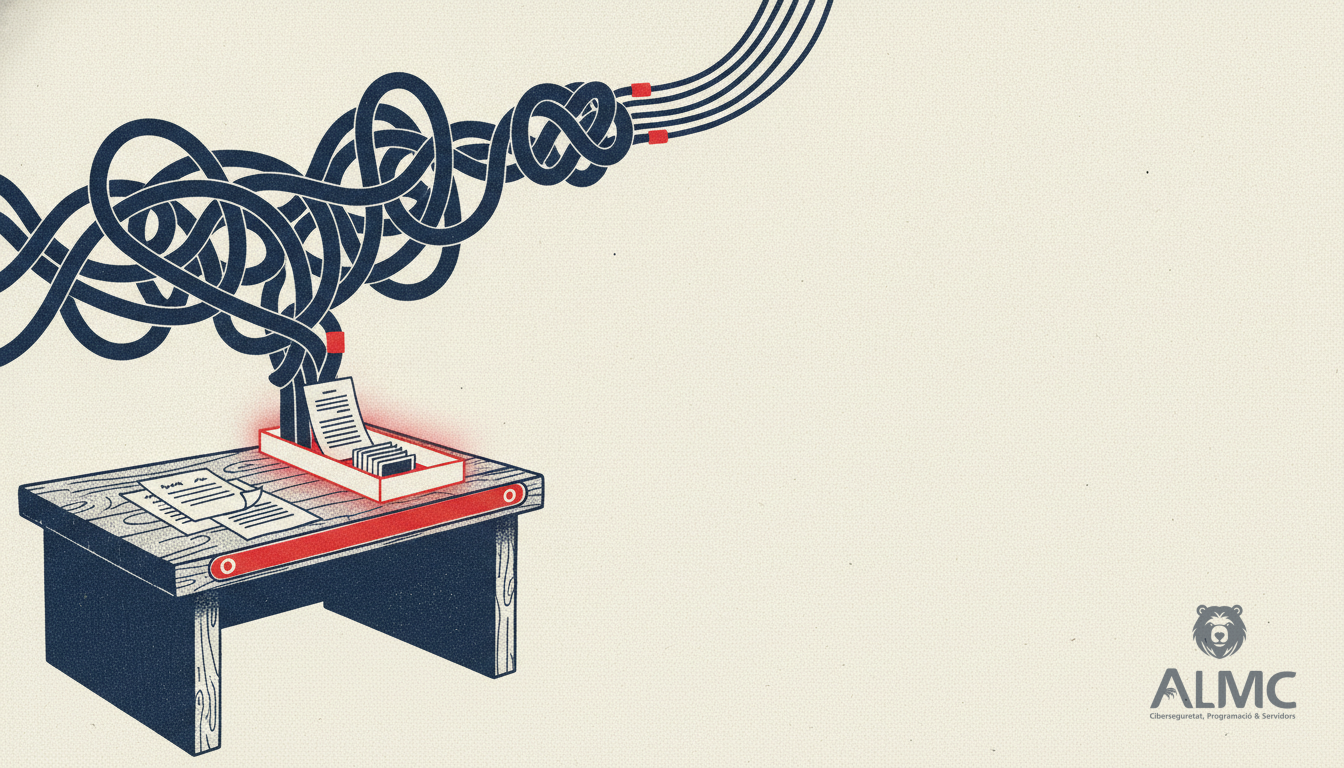
When a company in Lleida or Barcelona handles a handful of orders a week, a spreadsheet, an email inbox and a shared folder can just about cope. The trouble starts when volume rises: orders arrive through the sales team, email, web forms and ecommerce platforms, and each channel leaves its own trail. Information gets duplicated, documents go missing and nobody can say with certainty where a given order stands. That is not a people problem; it is a process problem, and it is exactly the kind of problem that automation solves.
Five warning signs your order process needs automating
- Scattered information. Orders live across inboxes, spreadsheets and shared drives with no common structure, so finding a single document becomes a small investigation.
- Slow, unclear approvals. When validation depends on informal messages, nobody knows who is responsible or which criteria were applied.
- Mismatches between order, delivery note and invoice. Different amounts, references or quantities slip through and only surface at payment time.
- No real-time visibility. Staff chase colleagues by phone or chat simply to learn the status of an order.
- Manual data entry. The same reference is typed into two or three systems, multiplying the chance of error.
What an order management system should actually cover
An order management system (OMS) is not just a database of purchases. It should organise the full lifecycle of an order: reception, validation, approval, tracking and archiving. The scope varies by tool. Some platforms specialise in omnichannel coordination, while ERP, CRM, warehouse and document management systems cover adjacent parts of the chain. Before buying anything, define which segment of the order cycle you need to control and which functions your current tools already provide. In most Catalan SMEs, the gap is not a missing ERP but missing connections between the tools already in place.
Key features to look for
Prioritise centralised storage with automatic document linking, configurable approval workflows with clear ownership, automatic matching between orders, delivery notes and invoices, and dashboards that show the real status of each operation. Equally important is integration capability: the system must talk to your ecommerce platform, accounting software and email without manual exports. This is where process automation platforms such as n8n become decisive, because they connect applications that were never designed to work together.
ERP, CRM or document manager: what does your SME really need?
An ERP is powerful but heavy; a CRM handles customer relationships but not logistics; a document manager organises files but does not necessarily trigger actions. For many small and medium businesses, the smartest route is not replacing everything but automating the flows between what already exists. Workflow automation lets you capture an order from any channel, validate it against predefined rules, notify the right person, generate the delivery note and reconcile it with the invoice, all without human copy-paste. The result is fewer errors, faster cycles and hours recovered every week.
How to choose without wasting budget
Start by mapping your current order process end to end and identifying where time is lost. Then check compatibility with your existing stack, the effort required to configure integrations, and whether the vendor offers ongoing support. Consider data protection from the outset: any tool handling customer or supplier data in Spain must comply with GDPR, so confirm where data is hosted and how access is controlled. Finally, favour solutions that can grow with you, adding new channels or approval rules without a full rebuild.
Common mistakes to avoid
Buying software before defining the process, automating a broken workflow, ignoring integration with accounting, and underestimating staff training are the usual culprits. Automation amplifies whatever you feed it: if the underlying process is chaotic, you will simply get faster chaos.
A practical example for a Catalan SME
Imagine a distributor in Tarragona receiving orders by email and through its online shop. With a simple automation flow, each incoming order is logged in a central system, checked against stock, routed for approval if it exceeds a set amount, and matched against the corresponding invoice. The sales team stops retyping data, finance stops chasing documents and management sees the pipeline in real time. No giant ERP migration required, just well-connected tools.
Conclusion: less manual work, more control
Order management stops being a headache when information flows automatically between the systems you already use. For SMEs in Lleida, Girona, Barcelona and across Catalonia, automating repetitive tasks is no longer a luxury but a competitive necessity. The goal is simple: connect your tools, remove the manual steps and give your team back the hours they currently spend chasing documents.
Related
- n8n Automation Guide: Streamline Your Business Workflows in 2026
- How Much Does Process Automation Really Cost? A 2026 Guide for SMEs
- Best WordPress SEO Plugins 2026: Expert Comparison for Spanish Sites
- Chatbot IA
Put these ideas into practice
Talk to ALMC about a solution for your business. Explore your options or contact our team.