
Chatbot IA for SMEs: 24/7 Customer Service That Qualifies Leads
Chatbot IA for SMEs: 24/7 Customer Service That Qualifies Leads
Why your customers no longer wait until Monday morningIn Catalonia, a customer browsing your ecommerce at 23:40 on a Sunday does not send an email and...
Why your customers no longer wait until Monday morning
In Catalonia, a customer browsing your ecommerce at 23:40 on a Sunday does not send an email and wait. They open a chat window, ask a question and, if nobody answers within a minute or two, they move on to a competitor. The same happens on WhatsApp, which in Spain has become the default channel for everything from appointment confirmations to product queries. For small and medium-sized businesses in Barcelona, Lleida, Tarragona or Girona, this creates a familiar dilemma: you cannot afford a support team working around the clock, but you also cannot afford to lose the enquiries that arrive outside office hours.
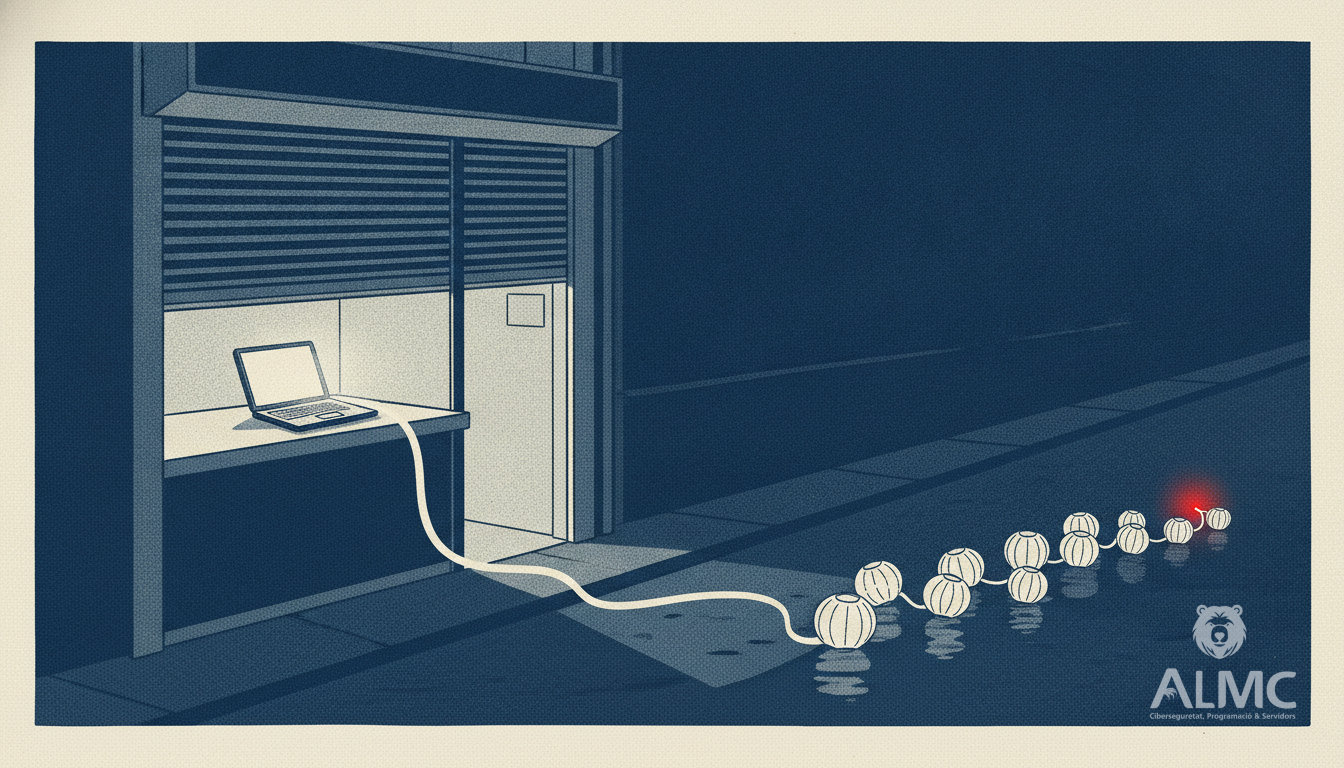
This is where an AI chatbot stops being a novelty and becomes a practical operational tool. A well-configured virtual assistant does not simply fire back canned replies. It understands the question, pulls the answer from your own documentation, and either resolves the query or hands it to a human with the context already gathered.
What conversational AI actually does for an SME
The shift from rule-based chatbots to conversational AI is what makes the difference. Older bots followed rigid decision trees: if the customer phrased the question differently, the conversation collapsed. Modern assistants built on large language models handle natural phrasing, typos and mixed Spanish-Catalan-English input without breaking down.
In practice, an automated customer service layer covers three jobs that otherwise consume most of a small team's day:
- Instant answers: delivery times, stock availability, return conditions, opening hours, warranty terms or how to use a product. These are repetitive questions, and they are exactly the ones a virtual assistant resolves best.
- Lead qualification: instead of collecting a name and an email and hoping for the best, the assistant asks the questions your sales team would ask — budget range, timeline, location, type of service required — and passes on only the enquiries that genuinely fit.
- Continuity across channels: the same assistant can serve your website and your chatbot WhatsApp number, so a conversation started on the web can continue on the phone without the customer repeating themselves.
Specialised models, not generic answers
One of the most important lessons from recent developments in open language models is that you do not need to train a model from scratch to make it an expert in your business. Techniques such as LoRA and QLoRA allow a foundational model to be adapted to a specific domain by training only a small set of additional parameters, rather than retraining billions of them. The practical consequence for a company in Lleida or Girona is significant: specialised assistants can be built and deployed on modest infrastructure, at a fraction of the cost and time that full retraining would require.
This matters because a generic chatbot that invents answers is worse than no chatbot at all. A specialised assistant grounded in your own catalogue, price lists and internal procedures — often combined with retrieval-augmented generation so that responses cite your real documentation — keeps answers accurate and auditable. It also means your data stays under your control, which is not a minor detail under the GDPR.
GDPR and data protection: what to settle before launch
Any assistant that handles customer conversations processes personal data, so the compliance groundwork should come first, not last. In the Spanish context, that means being clear about the legal basis for processing, informing users that they are talking to an AI system, defining retention periods for transcripts, and signing the corresponding data processing agreements with any provider involved. It is also worth deciding early whether conversations will be stored, anonymised or discarded, and documenting that decision.
None of this is exotic. It is the same discipline you already apply to your contact forms and newsletters, extended to a new channel. Handled properly, it becomes a selling point: customers increasingly appreciate knowing how their data is used.
Where the return actually shows up
The business case for a virtual assistant is rarely about replacing staff. It is about removing the low-value interruptions that fragment a small team's day. When the assistant absorbs routine questions, your people spend their time on the cases that need judgement: a complex quote, a complaint, a negotiation.
Three effects tend to appear within the first weeks:
- Faster first response. Enquiries receive an answer immediately, at any hour, which matters particularly for ecommerce customers comparing several suppliers at once.
- Better-qualified pipeline. Sales teams stop chasing contacts who were never going to buy, because the assistant has already filtered them.
- Lower cost per interaction. Routine queries are resolved without human involvement, freeing capacity during peak periods such as sales campaigns or holiday seasons.
It is worth being realistic about scope. An AI assistant will not resolve every case, and it should not try. The goal is a clean handover: when the conversation exceeds the assistant's competence, it transfers to a person with a summary of what has been discussed, so the customer never has to start over.
Getting started without overcomplicating it
For most SMEs and ecommerce businesses, the sensible path is incremental. Begin with a defined set of high-frequency questions and one channel — usually the website or WhatsApp — measure how many conversations are resolved without escalation, and expand from there. Review the transcripts regularly in the first month: they are the fastest way to spot gaps in your documentation and to refine the assistant's tone.
Choosing the right partner matters more than choosing the most advanced model. What you need is an assistant that speaks your customers' language, respects European data protection rules, and integrates with the tools you already use. Built that way, an AI chatbot stops being a gadget on your homepage and becomes part of how your business actually operates — answering at midnight as reliably as at midday.
Related
- Chatbot IA para Atención al Cliente: Guía para Pymes y Ecommerce en España
- AI Chatbots for WhatsApp Business: A Guide for Spanish SMEs
- Free Chatbot Options for SMEs: What You Get and What You Don't
- Automatización
Put these ideas into practice
Talk to ALMC about a solution for your business. Explore your options or contact our team.