
The Fly With a Brain: What Connectomes Mean for AI
The Fly With a Brain: What Connectomes Mean for AI
A fly that sees, reacts and movesA demo has been making the rounds in which a virtual fly, rendered through augmented reality, receives information ab...
A fly that sees, reacts and moves
A demo has been making the rounds in which a virtual fly, rendered through augmented reality, receives information about the world around it and responds using a nervous system rebuilt from the brain of a real fly. The creature can see, react and move its virtual body depending on what is in front of it. The quickest way to describe it is to say that someone has built an artificial fly with a brain of its own. The more interesting way is far less spectacular and far more technical: a computational model based on the neural wiring of a fly has been connected to an environment, closing the loop between perception and action.
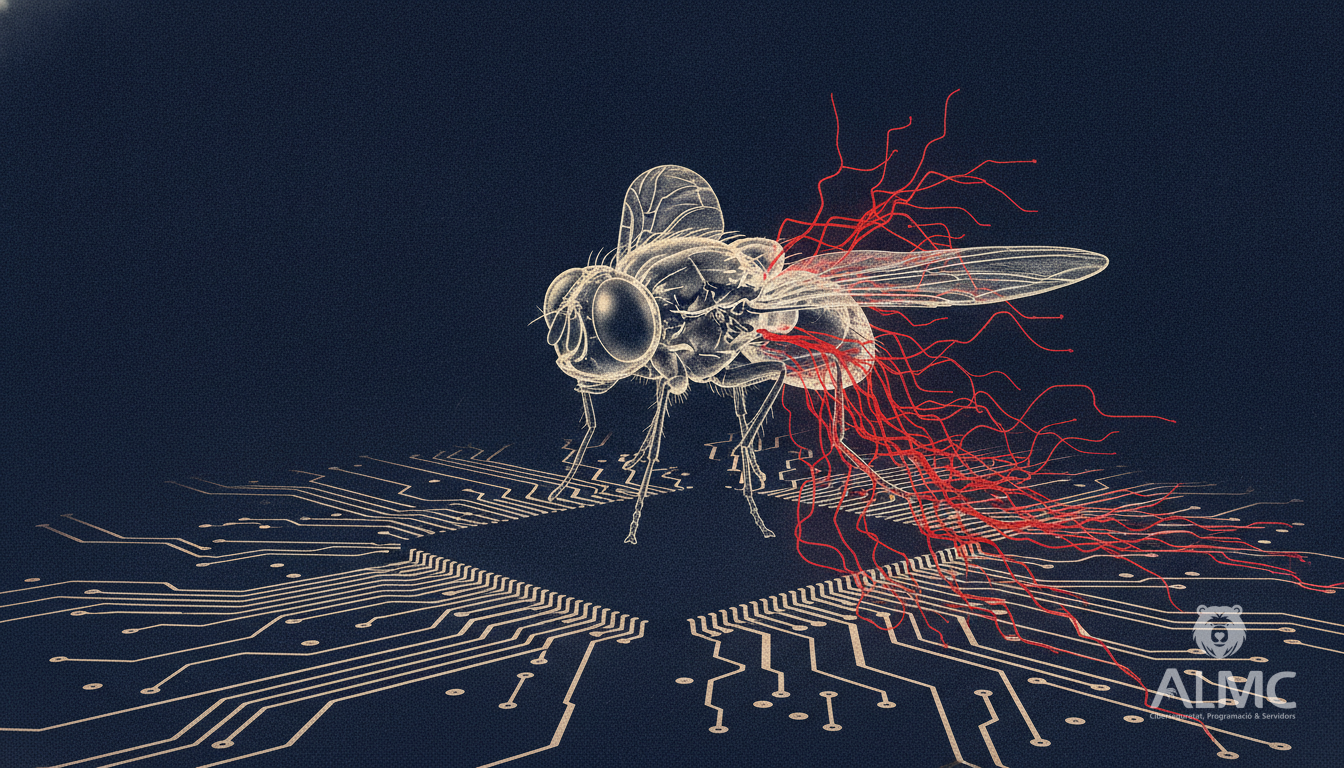
To understand why this matters, it helps to start a few squares back, because the word behind all of it — connectome — is likely to appear far more often in conversations about artificial intelligence from now on.
The brain as an enormous graph
A connectome is, broadly speaking, a map of the connections in a nervous system. Think of the brain as a network: neurons are the nodes, and synaptic connections are the edges that join them. The goal of connectomics is to reconstruct that graph in as much detail as possible.
The idea is not new. What has changed radically in recent years is our ability to gather the data required.
Rebuilding a brain this way is not a matter of taking a scan and getting a nice 3D image. To truly know the connectivity, you have to observe neural structures at microscopic scale, identify every neuron, trace its extensions and determine where it connects to other cells. In modern projects this means enormous volumes of electron microscopy, segmentation algorithms, three-dimensional reconstruction and a fair amount of human intervention to correct the errors that inevitably appear when turning microscopic images into a neural graph.
The result looks much more like rebuilding a network infrastructure from millions of captured packets than like taking a photograph of a brain.
And here an important distinction appears. A connectome tells us fundamentally how the system is wired, but it does not automatically contain everything needed to simulate its biological behaviour. Knowing that neuron A connects to neuron B does not, by itself, tell you about the dynamics of that connection: the neurotransmitters involved, the effective strength of the synapse, the electrical activity, the neuromodulation or the plasticity.
That is why a connectome is not a working brain. It is closer to the blueprint of an extremely complex machine. And having that blueprint becomes interesting once we are able to turn it into something executable.
The fly that allowed itself to be mapped
Drosophila melanogaster has been one of the stars of biological research for decades. Its small size, its life cycle and the huge range of available genetic tools have made the fruit fly one of the most studied model organisms. It also has another advantage for computing enthusiasts: its nervous system is small enough that full reconstruction is starting to become technically feasible.
That is precisely what makes the MaleCNS project so interesting. It reconstructs the complete central nervous system of an adult male Drosophila melanogaster. Version 1.0 contains around 166,700 neurons and 11,710 cell types, covering the central brain, the optic lobes and the ventral nerve cord.
In other words, we have something close to a complete inventory of the components and connections of a biological machine capable of perceiving its environment and producing behaviour. The dataset also allows connectivity to be queried through tools such as neuPrint, with programmatic access to neurons, synapses and the relationships between them.
For anyone coming from the world of software, there is something strangely familiar about all this: we can ask which neurons are connected, follow paths within the graph and study how a given sensory input can propagate through the system until it reaches circuits associated with motor behaviour. From the outside, a fly's brain starts to look like an infrastructure we can inspect with our own tools. The difference is that instead of looking for a route between two servers, we are following a neural route.
Why this matters beyond biology
The virtual fly is a striking demonstration, but the underlying lesson is broader. Connectomics is teaching us how to treat extremely complex systems as graphs that can be explored, queried and reasoned about — an approach that will feel familiar to anyone who manages servers, networks or security infrastructure.
In fact, the parallels are hard to ignore. When you run several machines, you are constantly trying to answer the same kinds of questions: what is connected to what, which paths are being used, and where does an unexpected event originate? Whether the nodes are neurons or servers, the challenge is the same — you need visibility into the whole system, not just one piece of it.
That is exactly the philosophy behind managed protection for servers. Tools such as fail2ban are powerful, but when they run in isolation on a single machine, they only ever see part of the picture. A malicious IP that hammers one server in Barcelona may simply move on to another in Lleida or Tarragona, and unless your defences share what they learn, each machine starts from zero.
A shared reputation feed changes that. When every server contributes what it observes and benefits from what the others detect, the whole estate becomes smarter than any individual node. Automatic blocking of malicious IPs, managed fail2ban across multiple machines and a common reputation feed turn a scattered set of servers into a coordinated system — much like a connectome turns isolated neurons into behaviour.
From mapping to protecting
There is a neat symmetry here. Researchers map the connections of a fly's brain to understand how perception becomes action. System administrators map the connections of their infrastructure to understand how traffic becomes behaviour — and, increasingly, to stop the behaviour they do not want.
For SMEs and hosting companies across Catalonia and the rest of Spain, the practical takeaway is straightforward. Cybersecurity is no longer about defending a single machine in isolation; it is about understanding the whole network and acting on it as one. Centralising protection, sharing IP reputation across servers and automating the response to threats is the infrastructure equivalent of closing the loop between perception and action.
The fly in the demo is a curiosity, and a fascinating one. But the idea underneath it — that complex systems become manageable once you can see how they are wired and act on that knowledge — is one that applies just as well to the servers running your business. GDPR compliance, uptime and peace of mind all depend on it.
Related
- How to Harden Your Servers with Fail2ban and IP Reputation Feeds
- Fail2ban: Your First Line of Defense Against Unauthorized Server Access
- Critical libssh2 flaw: urgent patch for SSH servers
- Desarrollo web
Put these ideas into practice
Talk to ALMC about a solution for your business. Explore your options or contact our team.