
Abuse Shield: Centralised Server Protection for SMEs in Catalonia
Abuse Shield: Centralised Server Protection for SMEs in Catalonia
Why per-server firewalls no longer scaleMost SMEs in Barcelona, Lleida, Tarragona and Girona start with a single server and a hand-tuned fail2ban conf...
Why per-server firewalls no longer scale
Most SMEs in Barcelona, Lleida, Tarragona and Girona start with a single server and a hand-tuned fail2ban configuration. It works. Then a second machine appears, then a third, and suddenly every administrator is copying jail files between hosts, chasing inconsistent thresholds and wondering why an IP that was banned on the web server is still happily probing SSH on the database box.
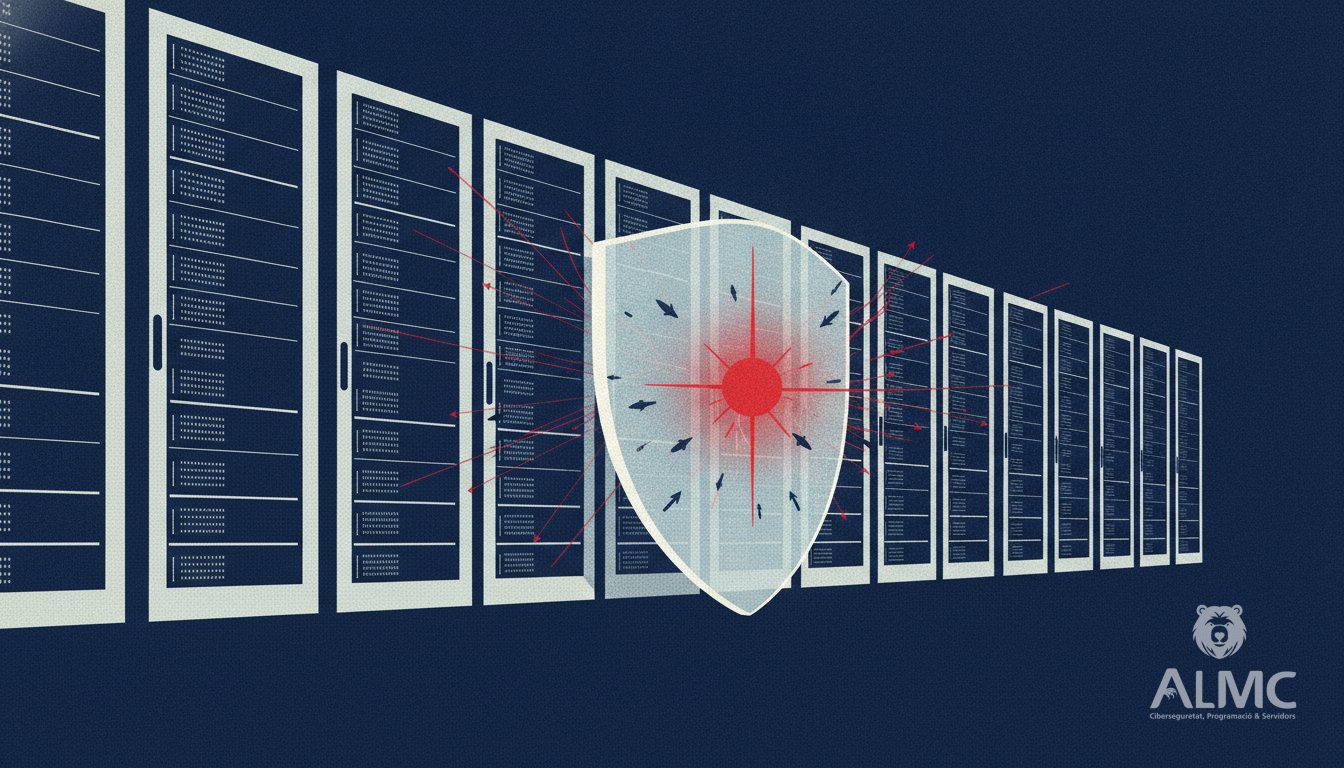
The problem is not fail2ban itself — it is the lack of a shared brain. Each server learns the same lessons from scratch, and the attacker only needs to find the one machine where the rules were never updated. Centralising that logic is exactly what Abuse Shield was built for: managed fail2ban across multiple machines, automatic blocking of malicious IPs, and a reputation feed that every connected server can read and contribute to.
The real cost of fragmented protection
When protection lives in silos, three things tend to happen. First, response time suffers: an incident detected on one host may take hours to be replicated elsewhere, if it is replicated at all. Second, false positives multiply, because each machine applies its own interpretation of what "suspicious" means. Third, reporting becomes guesswork — nobody can say with confidence how many unique IPs were blocked last month across the fleet.
For hosting companies this is even more acute. A single abusive client can generate traffic that hits dozens of servers, and without a shared reputation layer each one has to rediscover the same bad actor independently. Abuse Shield turns that fragmented effort into a single, coherent defence perimeter.
How Abuse Shield works in practice
The service sits between your servers and the open internet, acting as a coordination layer rather than a replacement for your existing stack. The core pieces are straightforward:
- Managed fail2ban: jails, thresholds and ban durations are defined once and deployed consistently across every enrolled machine, so a rule change reaches the whole fleet without manual SSH sessions.
- Automatic IP blocking: when a host detects abusive behaviour, the offending address is blocked immediately and the event is recorded centrally.
- Shared reputation feed: bans and suspicious signals are propagated between servers, so an IP that attacks one machine is pre-emptively blocked on the rest.
- Centralised visibility: a single view of what was blocked, where and why, which is invaluable when you need to justify a decision to a client or an auditor.
Because the feed is shared, the marginal cost of adding a new server is close to zero from a security standpoint: it inherits the accumulated knowledge of the whole fleet from day one.
Built for GDPR-conscious teams
IP addresses are personal data under the GDPR, and Spanish and Catalan companies are rightly careful about where that data travels. Abuse Shield is designed with EU hosting and data-minimisation principles in mind: only the technical signals needed for blocking are shared, retention is bounded, and the processing basis is legitimate interest in network security. For SMEs without a dedicated DPO, having that logic handled by a managed service removes a significant compliance burden.
Who benefits most
System administrators appreciate not having to maintain parallel fail2ban configurations. Hosting providers gain a defensible answer when a customer asks how abuse from neighbouring tenants is contained. And SMEs with their own servers — from a Lleida logistics firm running an ERP to a Girona agency hosting client sites — get enterprise-grade coordination without hiring a security team.
The pattern is always the same: the attacker probes, one server notices, and the whole fleet responds. That is the difference between a collection of individually defended machines and an actual security posture.
Getting started without disruption
Adoption is incremental. Servers can be enrolled one at a time, existing fail2ban rules can be imported, and the shared feed starts contributing value as soon as the second machine joins. There is no need to rip out your current firewall or reverse proxy; Abuse Shield complements them.
If you are running more than one server and still treating each as an island, the question is not whether centralised protection is worth it, but how much longer you can afford to coordinate it by hand.
Related
- How to Harden Your Servers with Fail2ban and IP Reputation Feeds
- Fail2ban: Your First Line of Defense Against Unauthorized Server Access
- Critical libssh2 flaw: urgent patch for SSH servers
- Desarrollo web
Put these ideas into practice
Talk to ALMC about a solution for your business. Explore your options or contact our team.