
Server Security: Centralised IP Blocking with Abuse Shield
Server Security: Centralised IP Blocking with Abuse Shield
Why the hardest part of server security is no longer the toolingMost teams running their own infrastructure already know what they should be doing. Th...
Why the hardest part of server security is no longer the tooling
Most teams running their own infrastructure already know what they should be doing. They have a firewall, they have fail2ban installed, and they have a rough idea of which services are exposed to the internet. The problem is rarely a lack of awareness. It is the gap between knowing what to do and actually doing it consistently across every machine you are responsible for.
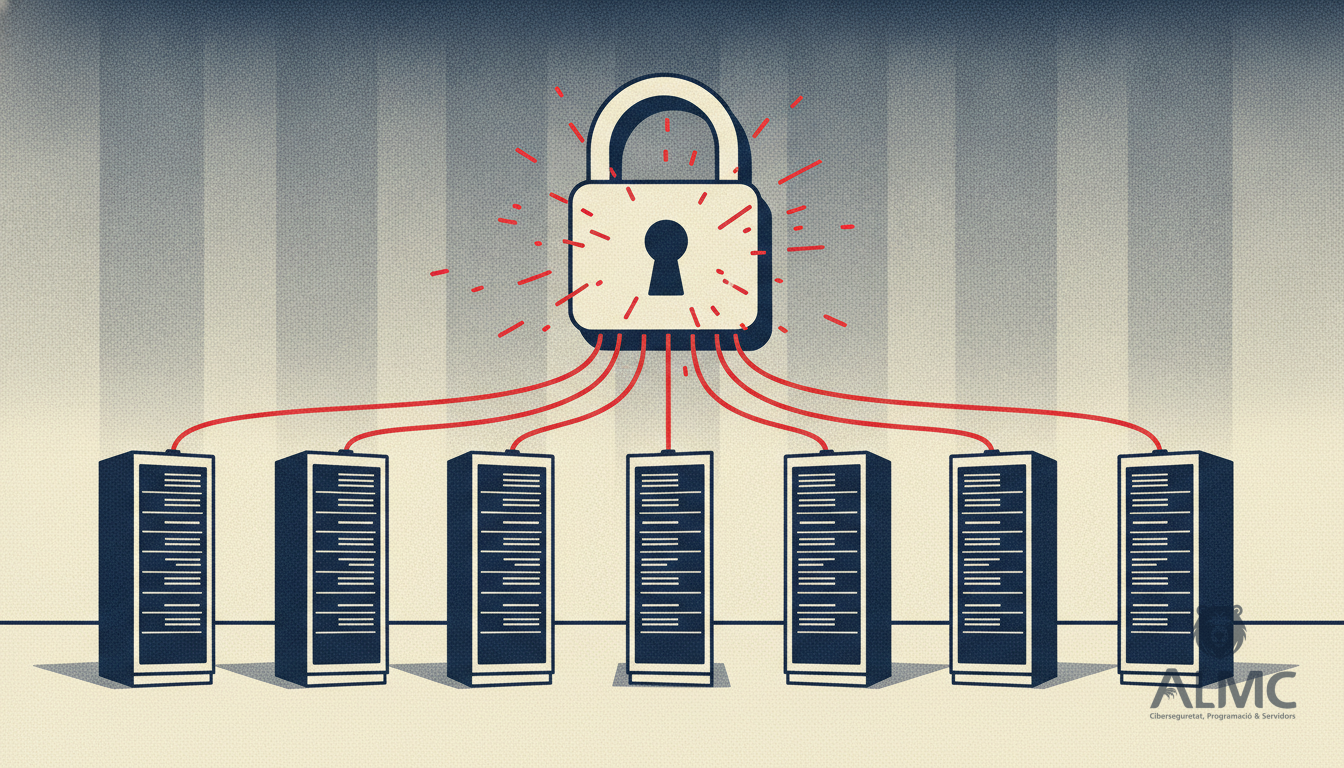
That gap has widened as infrastructures have grown. A small hosting provider in Lleida might run a dozen virtual machines; a company in Barcelona with its own platform could easily be managing three times that, spread across a couple of data centres and a hybrid cloud setup. Each machine has its own logs, its own ban lists and its own idea of which IP addresses are dangerous. An attacker who gets blocked on one server is free to try the same credentials on the next one, because nothing connects the two.
This is the operational reality that Abuse Shield was built to address: not a lack of security features, but a lack of coordination between the servers that already have them.
The real cost of managing fail2ban machine by machine
fail2ban remains one of the most effective and lightweight tools available for blocking brute-force attempts against SSH, mail services, web panels and custom applications. It is mature, well documented and works on virtually any Linux distribution. None of that is in question.
The friction appears at scale. Consider what a typical week looks like when you manage protection per host:
- You configure jails and thresholds separately on each server, then try to keep those configurations in sync as machines are added or rebuilt.
- You check logs individually, often only after something has gone wrong, because nobody has time to review every host daily.
- You investigate an IP that has been hammering one machine, then discover it has already been probing four others without triggering the same rules.
- You handle false positives one by one, unbanning legitimate customers or monitoring tools from each affected server.
- You rely on a single administrator's memory to know which exceptions exist and why.
Individually, none of these tasks is difficult. Collectively, they consume hours that could be spent on architecture, capacity planning or the projects that actually generate revenue. And they leave a structural weakness in place: an attacker only needs to find the one host where the rules are slightly looser.
What a shared reputation feed changes
The core idea behind Abuse Shield is simple to describe and genuinely useful in practice. Instead of each server learning about malicious IP addresses on its own, every protected machine contributes to and reads from a common reputation feed. When one server detects abusive behaviour and blocks an address, that information becomes available to the rest of the fleet.
The practical consequences are significant:
- Faster containment. An address that starts attacking one host is blocked across the infrastructure before it has time to rotate through the others.
- Less noise. Coordinated blocking means fewer repeated incidents to triage, because the same actor is stopped once rather than repeatedly.
- Consistent policy. Thresholds and rules are managed centrally, so a newly provisioned server inherits the same protection as the rest from day one.
- Better visibility. A single view of blocked addresses and recent activity replaces the chore of logging into each machine separately.
This is the difference between a collection of individually defended servers and an infrastructure that defends itself as a unit.
Managed fail2ban without the maintenance burden
Abuse Shield does not ask you to abandon fail2ban. It manages it for you across multiple machines, which is exactly where most of the effort traditionally goes. Configuration is centralised, updates propagate to the whole fleet, and the day-to-day work of keeping jails effective is handled as part of the service.
For system administrators, this removes a recurring maintenance task without removing control. For hosting companies, it means new customer servers can be brought under protection quickly and uniformly, which is a meaningful selling point when clients ask how their infrastructure is secured. For small and medium businesses running their own servers, it closes a skills gap that is difficult to fill internally, particularly when there is no dedicated security role on the payroll.
Fitting into a wider security picture
It is worth being clear about what this kind of protection does and does not cover. Centralised IP blocking and shared reputation are highly effective against automated abuse: credential stuffing, SSH brute force, scraping, comment spam and the constant background scanning that every public server experiences. They are not a substitute for patching, least-privilege access, encrypted backups or application-level security testing.
What they do provide is a solid, low-maintenance baseline that reduces exposure and frees up attention for the risks that require human judgement. In a market where specialised skills are increasingly scarce and expensive, automating the repetitive defensive layer is one of the most sensible investments a small team can make.
Compliance and data protection considerations
For organisations operating in Spain and across the EU, any system that processes IP addresses is handling personal data under the GDPR. A well-run reputation feed should therefore be designed with data minimisation in mind: retaining what is necessary to identify abusive behaviour, applying appropriate retention periods, and documenting the legitimate interest that justifies the processing. Centralising this activity also makes it easier to audit, which is an advantage when a client or a supervisory authority asks how access attempts are being monitored and controlled.
Who benefits most
The clearest gains appear in three situations. Hosting providers managing many customer machines, where per-host configuration simply does not scale. Companies with a handful of servers and no dedicated security engineer, where consistency matters more than sophistication. And system administrators who would rather spend their week improving infrastructure than repeating the same fail2ban tuning on every new deployment.
If any of those describes your situation, centralising protection is probably overdue. The good news is that it does not require rebuilding your stack, only connecting the pieces you already have.
Related
- How to Harden Your Servers with Fail2ban and IP Reputation Feeds
- Fail2ban: Your First Line of Defense Against Unauthorized Server Access
- Critical libssh2 flaw: urgent patch for SSH servers
- Desarrollo web
Put these ideas into practice
Talk to ALMC about a solution for your business. Explore your options or contact our team.