
Building an Online Store That Actually Sells in Spain
Building an Online Store That Actually Sells in Spain
Spain's online shoppers have grown upEcommerce in Spain is no longer a land grab. With tens of millions of people buying online, the market has mature...
Spain's online shoppers have grown up
Ecommerce in Spain is no longer a land grab. With tens of millions of people buying online, the market has matured to the point where the interesting question is no longer "how many customers can we reach?" but "how often do they come back, and how much do they spend when they do?". Growth now comes from frequency and basket value, not from simply being present on the internet.
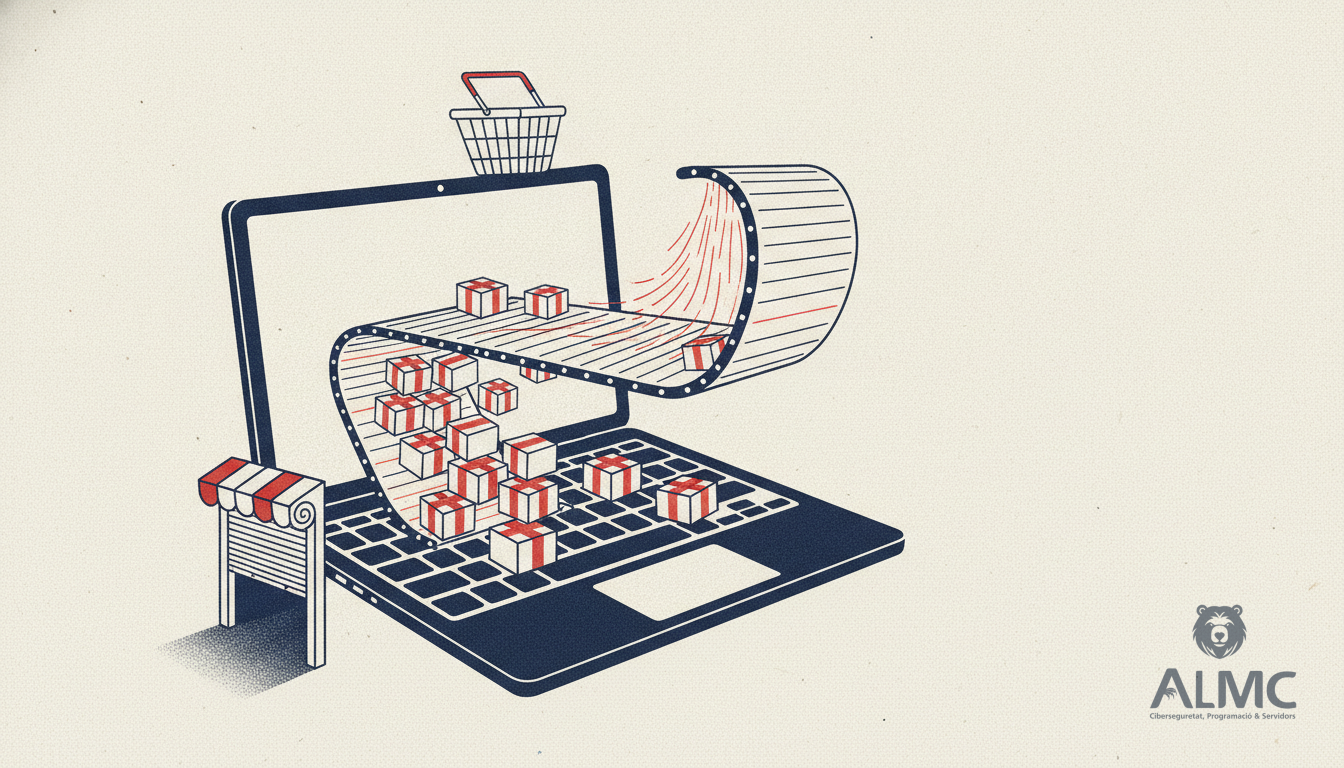
That shift changes what a business needs from its online store. A shop that looks fine on launch day but leaks visitors at checkout, loads slowly on mobile or buries its best products three clicks deep will not capture that repeat custom. At ALMC.es, working from Lleida with clients across Catalonia and the rest of Spain, we build online stores that are designed to sell from day one: PrestaShop and WooCommerce tailored to the business, conversion optimisation baked in, and the full stack needed to compete properly in ecommerce.
Why the platform choice matters less than the fit
PrestaShop and WooCommerce are both mature, open and widely supported in Spain, and both can carry a serious catalogue. The difference is rarely the logo on the tin; it is how well the platform matches your catalogue, your operations and your team.
- PrestaShop tends to suit retailers with large or structured catalogues, multiple combinations, languages and a need for back-office workflows that a shop manager can run without a developer on call.
- WooCommerce shines when content and commerce belong together, when the brand already publishes on WordPress, or when the roadmap involves custom features and integrations that benefit from a flexible plugin ecosystem.
Rather than forcing a favourite, we start from your product data, your fulfilment process and how your team actually works. A store built around those realities ages far better than one chosen for a trend.
Conversion is a discipline, not a redesign
Most lost sales are not dramatic. They are small frictions: a shipping cost that appears too late, a form that asks for a phone number nobody wants to give, a search that returns nothing for a common synonym, a product page with one flat photo. Conversion optimisation is the work of finding and removing those frictions, then measuring what changed.
In practice that means looking closely at the checkout flow, the clarity of delivery and returns information, the speed of the site on a mid-range phone over mobile data, and the quality of product content. It also means respecting how people in Spain actually pay: cards, yes, but also local habits and the expectation of clear invoicing. Every change should be tied to a measurable outcome, whether that is a higher completion rate or a larger average basket.
Trust, privacy and the Spanish legal reality
Selling online in Spain means operating under GDPR and Spanish data protection rules, and customers notice when a shop handles this well. Cookie consent that is genuinely optional, transparent privacy information, secure payment handling and clear terms all reduce hesitation at the moment of purchase. For B2B sellers, correct invoicing and record-keeping are part of the same trust equation.
This is also where a store's technical foundations show their worth. A well-maintained stack, sensible backups, up-to-date software and a hosting setup sized for traffic peaks are not glamorous, but they are what keeps a shop open during a campaign instead of timing out.
What a store that sells actually needs
Beyond the launch, a competitive ecommerce operation in Catalonia or anywhere in Spain tends to rest on a few practical pillars:
- Clean product data that feeds search, filters and marketplaces without manual rework.
- Integrations with stock, accounting, carriers and invoicing so operations do not depend on copy-paste.
- Performance tuned for mobile shoppers, since that is where most browsing happens.
- Analytics you trust, so decisions about promotions and assortment are based on evidence.
- A maintenance plan, because an online store is a living system, not a finished project.
The commercial landscape keeps moving, with new AI-driven shopping experiences and changing search behaviour on the horizon. Stores built on solid, well-integrated foundations can adopt those changes as they arrive. Those held together with shortcuts usually cannot. If you are planning a new online store or wondering why the current one underperforms, the most useful first step is an honest look at where the sales are actually being lost.
Related
- WooCommerce vs PrestaShop: Which Ecommerce Platform Wins in 2025?
- CRO for Ecommerce: Turning WooCommerce and PrestaShop Templates into Sales Engines
- Agentic Commerce: How AI Agents Are Rewriting the Rules of Online Shopping
- Desarrollo web
Put these ideas into practice
Talk to ALMC about a solution for your business. Explore your options or contact our team.