
Retail media in-store: what online shops can learn
Retail media in-store: what online shops can learn
Retail media moves from the aisle to the screenSpanish grocery chains have spent the past few years turning their stores into advertising networks. On...
Retail media moves from the aisle to the screen
Spanish grocery chains have spent the past few years turning their stores into advertising networks. One of the most visible examples is the rollout of new digital signage across dozens of supermarkets and hypermarkets, integrated into a network of several hundred screens that already spans videowalls, shelf-edge devices and checkout displays. The interesting part is not the hardware: it is the logic behind it. Campaigns are planned using first-party data about who visits, when, what they buy and how they respond to promotions, and then measured against comparable stores to see whether sales and category share actually moved.
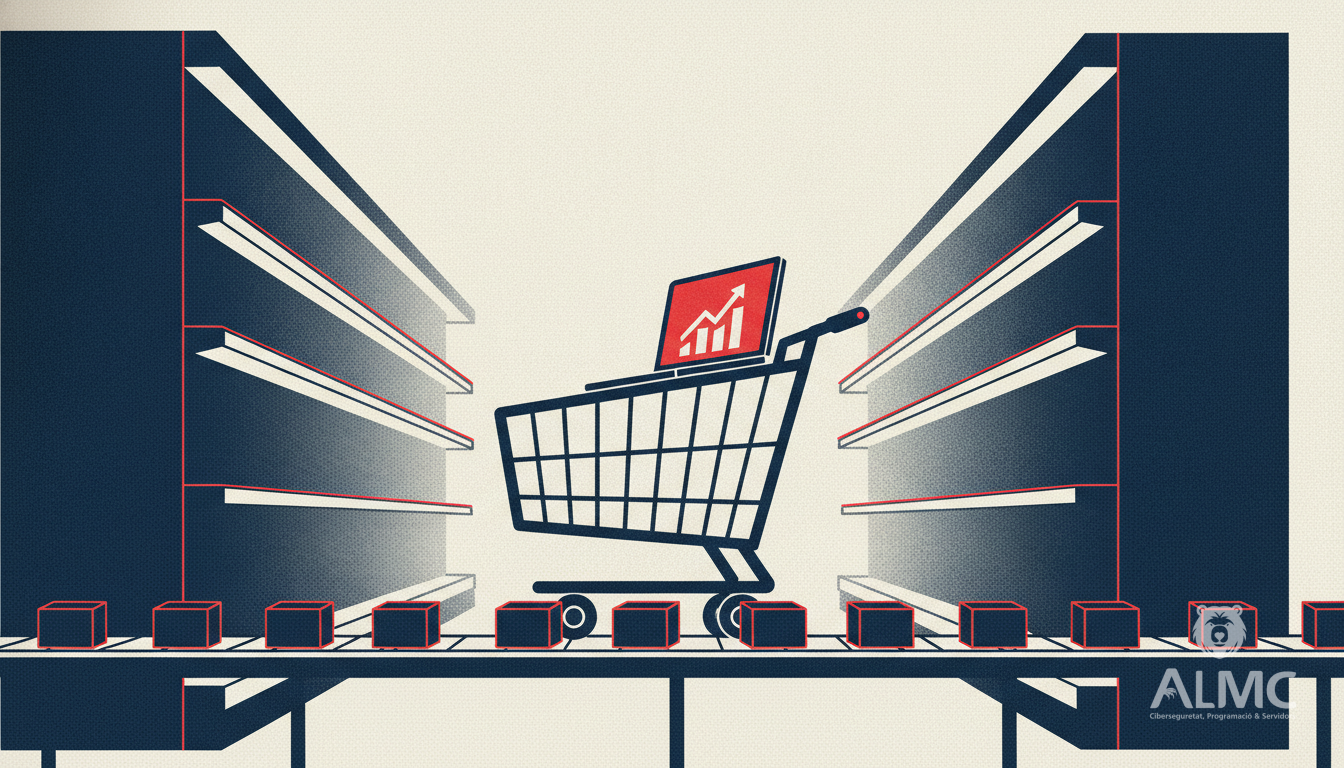
For anyone running an ecommerce operation in Catalonia, that model is worth studying closely. The mechanics of retail media in a physical store map almost one-to-one onto what a well-built online store should be doing with its own data. If a supermarket can decide which screen shows which message at which hour, your shop can decide which product, banner or recommendation appears to which visitor at which moment of the journey.
First-party data is the real asset
Notice what makes the in-store model work: the retailer owns the relationship with the shopper and knows their habits. No third-party cookie is required. Online merchants in Lleida, Barcelona, Tarragona or Girona sit on exactly the same kind of asset, often without realising it: order history, browsing behaviour, wishlists, newsletter engagement, support conversations. The question is whether that data is actually connected to the storefront.
In our experience building PrestaShop and WooCommerce shops, the gap is usually technical rather than strategic. Customer records live in the ERP, browsing data lives in an analytics tool, and the product catalogue lives somewhere else entirely. When those three are joined up, personalisation stops being a nice-to-have and becomes a planning tool:
- Segmenting visitors by purchase frequency and category affinity, not just demographics.
- Prioritising which products appear on the homepage depending on stock, margin and seasonality.
- Timing promotions to match when your audience actually shops, rather than when your team happens to publish.
- Measuring every campaign against a control group, the same way a retailer compares a test store with a mirror store.
Measurement is where most shops fall short
The most instructive detail in the retail media example is the discipline of comparison. Campaigns are judged against reference stores and against each campaign's own history. Most small and mid-sized online shops do neither: they look at revenue after a promotion and assume the uplift was caused by it.
A conversion-focused ecommerce setup should make this easier. That means clean event tracking, a properly configured consent flow under GDPR, and dashboards that separate traffic effects from conversion effects. When you can see that a campaign lifted add-to-cart rate but not checkout completion, you learn something actionable about your payment step or shipping costs. When you cannot, you are guessing with a budget.
What this means for your online shop
Retail media is often framed as a way for brands to reach shoppers in store. For an online merchant, the more useful reading is that the same principles apply to your own storefront: own your audience data, connect it to the shopping experience, and measure against a baseline. That is the difference between a website that displays products and a tienda online that genuinely sells.
In practical terms, a modern commerce stack in Spain needs a few things working together: a fast, well-structured PrestaShop or WooCommerce front end, a product information layer that stays consistent across channels, analytics and consent management that respect GDPR, and integrations with invoicing, logistics and stock systems so that the data feeding your decisions is accurate. Add automation where it pays off, such as abandoned-cart recovery or post-purchase communication, and the whole operation starts to behave less like a brochure and more like a retail channel.
A note on local context
Catalonia has a dense retail fabric, from family shops in Lleida's old town to brands selling across the EU from Barcelona. Competition is real, and margins are thin. The advantage of a well-engineered online store is not that it looks modern, but that it compounds: every improvement in conversion rate, every recovered cart, every correctly attributed campaign makes the next decision cheaper and more reliable.
Retail media in supermarkets shows what happens when a business treats its own data as a planning instrument rather than a by-product. Online shops have the same raw material, and often better measurement. The work is in joining it up.
Related
- WooCommerce vs PrestaShop: Which Ecommerce Platform Wins in 2025?
- CRO for Ecommerce: Turning WooCommerce and PrestaShop Templates into Sales Engines
- Agentic Commerce: How AI Agents Are Rewriting the Rules of Online Shopping
- Desarrollo web
Put these ideas into practice
Talk to ALMC about a solution for your business. Explore your options or contact our team.