
Blog
Agentic commerce: when AI starts shopping for your customers
The assistant stops answering and starts actingFor years, the promise of artificial intelligence in retail was conversational: a chatbot that answered...
The assistant stops answering and starts acting
For years, the promise of artificial intelligence in retail was conversational: a chatbot that answered questions about delivery times and returns. That phase is closing. The big platforms are now pushing agents that take a request, break it into steps and carry it out in the background — checking prices, comparing stock, drafting an order and asking for confirmation before anything is paid. Google has moved in this direction by folding its experimental task agent into its main assistant and opening it up beyond paid plans in a handful of markets.
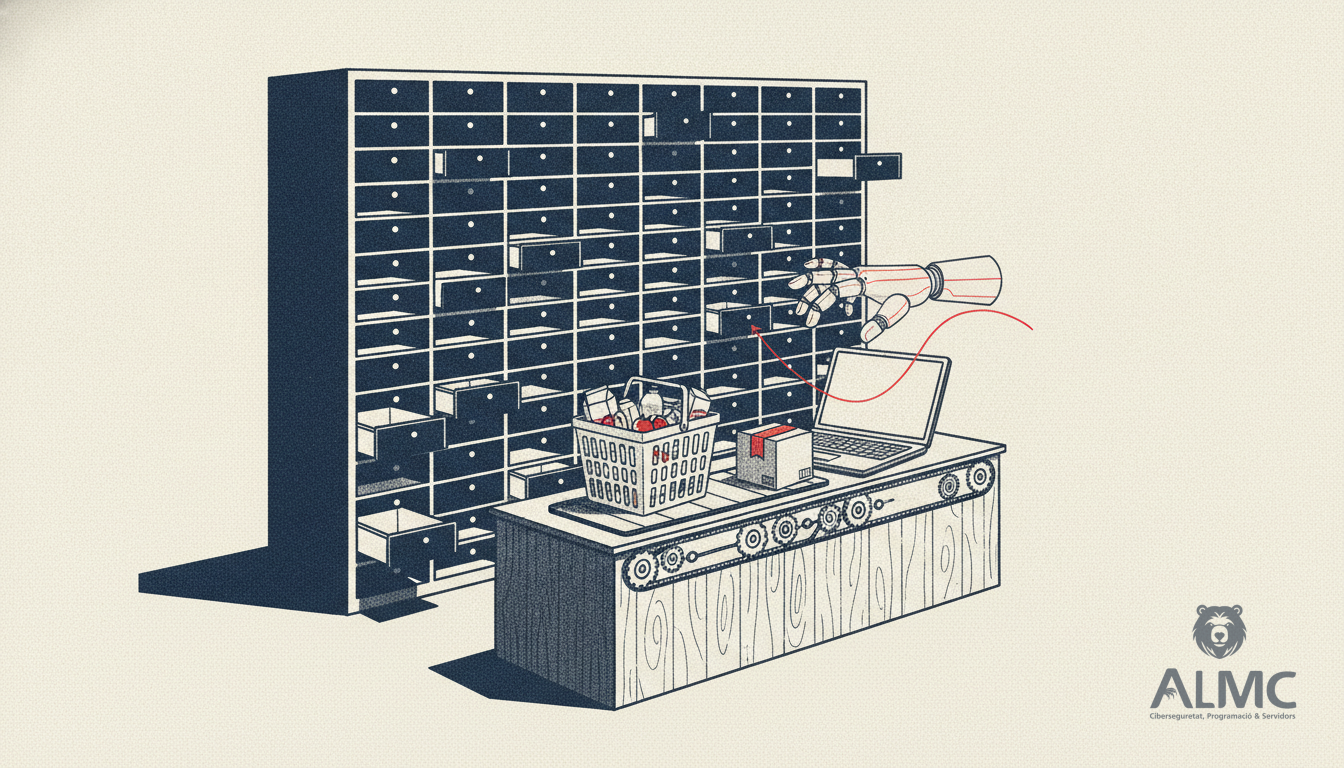
For anyone running an online shop in Lleida, Barcelona or Girona, the interesting part is not the product name or the launch calendar. It is the shift in who does the browsing. When a software agent visits your catalogue instead of a person, some of the assumptions behind your storefront start to wobble.
What changes when the visitor is software
A human shopper tolerates a certain amount of friction: a cookie banner, a slider, a pop-up offering ten per cent off, a checkout that asks for an account before showing shipping costs. An agent has neither patience nor curiosity. It reads what is machine-readable and moves on.
- Product data becomes the shop window. Structured titles, complete attributes, sizes, materials, compatibility and clear stock status matter more than a beautiful hero image.
- Price and availability need to be unambiguous. If your stock figure lives only inside a JavaScript widget, an agent may simply conclude the item is unavailable.
- Checkout must survive without a human hand. Guest checkout, saved payment methods and short forms reduce the number of steps where an automated purchase stalls.
- Consent and permissions get complicated. An agent acting for a customer still operates under European data protection rules, and the customer remains responsible for what it authorises.
A Spanish reality check
It is worth keeping expectations calibrated. The most advanced capabilities — an assistant phoning a shop to check stock, or preparing a payment through a wallet — are being rolled out market by market, and the European Economic Area is not first in line. Spanish shoppers will not wake up tomorrow to an agent doing their weekly grocery run. What is arriving now is the groundwork: assistants that read pages, summarise options and prepare baskets, plus a growing number of third-party tools built on the same idea.
That gap is useful. It gives merchants in Catalonia time to prepare the boring, unglamorous foundations that make a store legible to both people and machines, without rebuilding everything from scratch.
Practical groundwork for a PrestaShop or WooCommerce store
Most of the work is familiar ecommerce hygiene, sharpened. Start with the product feed: consistent naming, complete descriptions, correct categories, and prices that include VAT in the way Spanish customers expect. Then look at performance — an agent with a timeout behaves like an impatient customer, and a slow page is a closed door.
Next, review the checkout as a sequence of decisions rather than a form. Every mandatory field is a place where an automated flow can fail, and every unclear shipping threshold is a reason to abandon. Payment methods deserve attention too: local options such as cards, Bizum and transfer still carry weight with Spanish buyers, and their absence undermines trust even when the buyer is not human.
Finally, think about how you will know an agent visited. Server logs, conversion paths and abandoned cart data tell a story; if a large share of sessions browse many products and never approach checkout, that may be a machine comparing you against competitors rather than a person losing interest.
Where a specialist shop build helps
None of this requires a radical replatforming, but it does require a store built with intent rather than assembled from plugins. At ALMC we build online shops on PrestaShop and WooCommerce tailored to how each business actually sells, with conversion optimisation baked into the structure — clean product data, fast pages, a checkout that does not fight the buyer, and the surrounding stack of hosting, analytics and integrations that keeps it all running.
The agentic wave will reward shops that are easy to read, easy to trust and easy to buy from. Those are the same qualities that have always worked on human customers, which is a reassuring place to start.
Related
- WooCommerce vs PrestaShop: Which Ecommerce Platform Wins in 2025?
- CRO for Ecommerce: Turning WooCommerce and PrestaShop Templates into Sales Engines
- Agentic Commerce: How AI Agents Are Rewriting the Rules of Online Shopping
- Desarrollo web
Put these ideas into practice
Talk to ALMC about a solution for your business. Explore your options or contact our team.