
Mobile Apps for Smart Buildings: The Interface of the Intelligent Office
Mobile Apps for Smart Buildings: The Interface of the Intelligent Office
From sensors to decisions: the missing layer in most smart buildingsWalk into almost any recently refurbished corporate building in Barcelona's 22@ di...
From sensors to decisions: the missing layer in most smart buildings
Walk into almost any recently refurbished corporate building in Barcelona's 22@ district or in the business parks around Lleida and you will find sensors everywhere: temperature probes, CO2 meters, presence detectors, energy sub-meters. The hardware is rarely the problem. The problem is that all that data often stays locked inside a dashboard that only the facilities manager ever opens. A building is not intelligent because it measures things; it is intelligent because the people inside it can act on what is measured. That is precisely where a well-designed mobile application changes the equation.
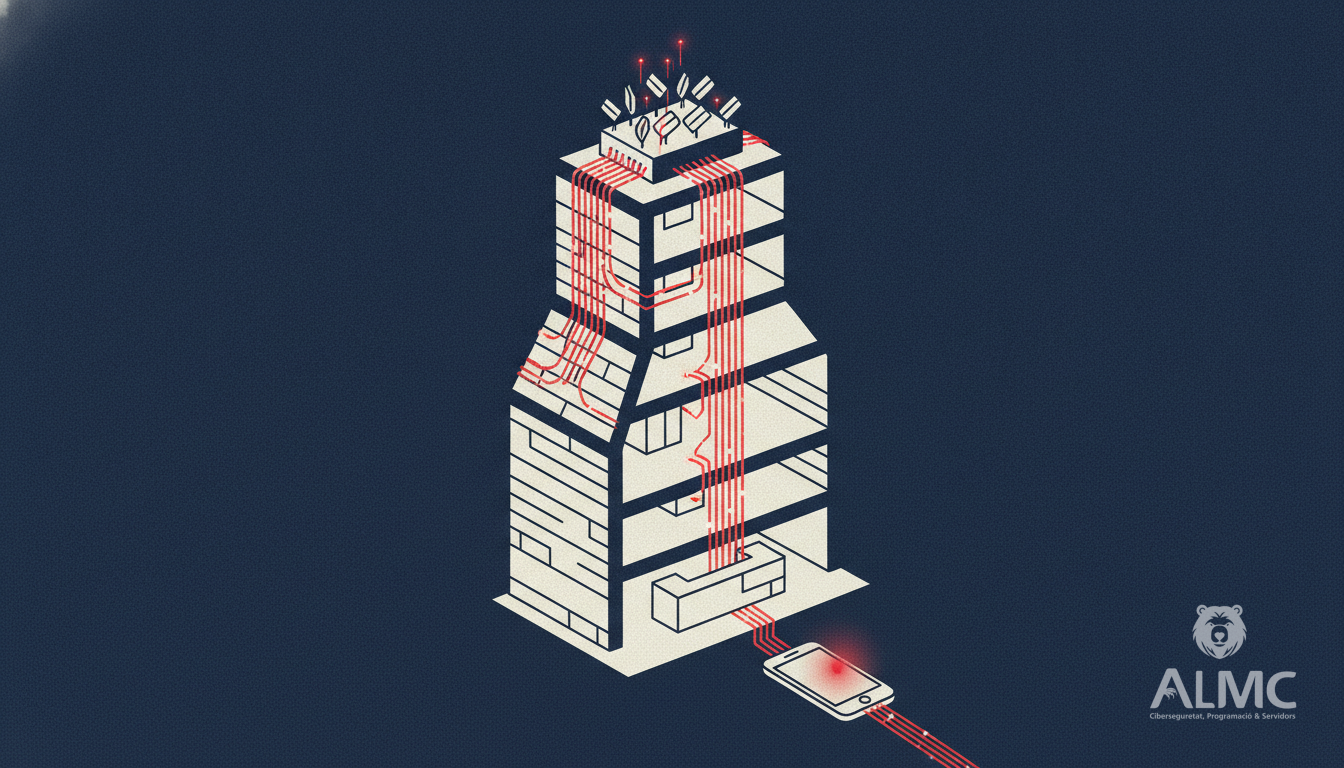
At ALMC.es we build custom apps for iOS and Android, and an increasing share of our work in Catalonia involves connecting those apps to building management systems. This article explains what that integration actually requires, and why it deserves a line in your digitalisation budget.
Inmotics, not home automation: a different scale entirely
One clarification worth making early, because it shapes every technical decision afterwards. Home automation manages isolated functions in a dwelling: a light, a thermostat, a smart plug. Inmotics manages an entire corporate or industrial building in a coordinated way, covering HVAC, access control, energy and security through a central platform known as a BMS or BAS. The distinction is not semantic. A home app controls a handful of devices; a building app sits on top of an ecosystem where thousands of data points feed automated decisions, such as pre-cooling a floor before occupancy peaks based on real usage patterns rather than a fixed timetable.
What sits underneath the app
Before writing a single line of mobile code, the architecture has to be understood. Three layers matter most:
- IoT sensors and edge computing. Processing data close to where it is generated, inside the building itself, reduces latency and keeps sensitive information on the local network instead of shipping it wholesale to a public cloud. We prioritise this from the design stage, because retrofitting privacy later is expensive.
- Open protocols. BACnet and KNX dominate HVAC and lighting control, LoRaWAN links low-power wireless sensors over long distances, and MQTT carries the resulting data towards cloud or edge platforms. In practice, not every manufacturer embraces open standards, and that single detail can complicate an integration more than any other factor. It is worth auditing before committing to a vendor.
- BIM and digital twins. BIM is not a 3D drawing; it is a collaborative database. Its energy-analysis and lifecycle-maintenance dimensions feed a digital twin that can simulate real scenarios, and the app becomes the human-readable window into that simulation.
Why the mobile app is the layer that actually gets used
Facilities managers will tolerate a complex desktop dashboard. Occupants will not. A mobile app connected through secure IoT architecture lets a facilities team monitor consumption in real time, adjust climate settings or manage access permissions from a phone, turning raw data into quick decisions. For employees, the same app can handle desk booking, visitor registration or reporting a fault in a meeting room. Adoption is what determines whether the investment pays back, and adoption follows convenience.
From a development perspective, this means treating the app as a product rather than a screen. Authentication has to comply with GDPR, since occupancy and access data are personal data under European rules. Communication between app and BMS must be segmented, because the convergence of corporate IT networks and operational OT networks is a genuine attack surface. Frameworks such as IEC 62443 and the NIST cybersecurity framework are the reference points here, and they should inform the architecture long before the first prototype.
The financial case, without the hype
For a developer or a construction CEO, the question is rarely technological. Industry studies cited in the real estate sector point to meaningful asset value uplifts and higher achievable rents for intelligent buildings, with technology payback periods typically measured in a handful of years thanks to energy and maintenance savings. We prefer to treat those figures as directional rather than guaranteed: the exact return depends on the building, its usage profile and how well the software layer is adopted. What is clear is that a smart building with an unused interface is a cost centre, while one with a well-adopted app is an operational advantage.
European regulation reinforces the trend. The Energy Performance of Buildings Directive pushes progressive decarbonisation of the non-residential stock, and the Smart Readiness Indicator measures how well a building can adapt to occupant and grid needs. A high SRI score supports the ESG criteria that institutional investors now scrutinise. An app that makes that readiness visible and usable is not a decorative extra; it is part of the evidence.
Where to start
Retrofitting an existing building is entirely feasible, and it usually begins with an audit of what protocols the installed systems already speak. From there, the sensible path is incremental: connect the highest-value data first, validate the app with real users, then expand. If your organisation is planning a smart building project in Lleida, Barcelona, Tarragona or Girona, the mobile layer deserves to be designed alongside the BMS rather than bolted on at the end.
Related
- 10 Mobile App Ideas to Transform Your Business in 2025
- The Mobile App Boom: Why Your Business Needs a Custom App in 2025
- Monetising Mobile Apps: Key Business Models for 2025
- Chatbot IA
Put these ideas into practice
Talk to ALMC about a solution for your business. Explore your options or contact our team.