
Custom Mobile Apps: Bringing NFC and Your Business to the Customer's Pocket
Custom Mobile Apps: Bringing NFC and Your Business to the Customer's Pocket
When a company in Lleida or Barcelona asks us about NFC cards, the first thing we usually do is widen the conversation. A card is only one of many car...
When a company in Lleida or Barcelona asks us about NFC cards, the first thing we usually do is widen the conversation. A card is only one of many carriers that can host the technology: wristbands, keyrings, labels, accreditation badges, industrial equipment or almost any object compatible with the standard. So the useful question is not which card to buy, but what should happen when someone holds their phone close to it.
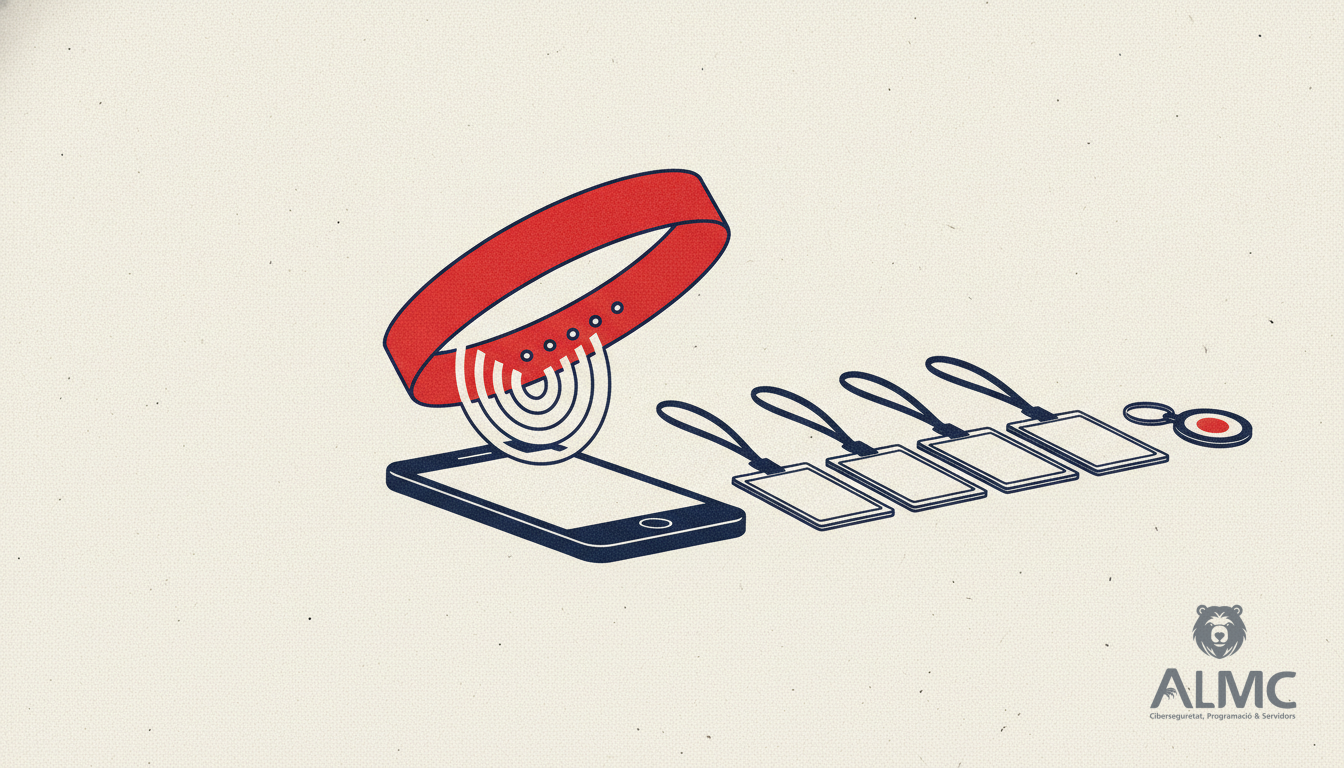
That shift in perspective is exactly where custom mobile app development comes in. In most serious projects, the physical tag is the visible tip of a much larger structure: an app, a backend, a database and, quite often, integrations with the systems the company already runs. This article explains where NFC genuinely adds value, when you need a bespoke app and how to approach the project without wasting budget.
What an NFC tag actually is (and is not)
An NFC tag contains a small chip and an antenna that exchange information over a very short distance with a compatible device, normally a smartphone. It needs no battery: the phone generates the field that powers the interaction. That simplicity is precisely what makes it so easy to misunderstand.
The carrier is not the solution. A tag can open a URL, identify a person, retrieve an assistant's details, trigger an action inside an app, log an interaction, pull up information about an asset, register a clock-in, identify a vehicle or exchange data during an event. But behind any of those outcomes there is usually software doing the real work.
One technology, many physical formats
Another common mistake is to associate NFC exclusively with the business card. The same chip can be embedded in formats chosen according to the environment, the durability required, the expected number of interactions and the experience you want to deliver:
- Events: accreditation badges or wristbands that identify attendees and capture leads.
- Corporate environments: keyrings for access, identification or time tracking.
- Industry: labels attached to physical equipment to consult manuals, history or maintenance status.
- Retail and hospitality: table tags, product labels or loyalty supports.
The sensible order is always the same: define the use case first, then choose the carrier, then decide on the software.
Do you need to develop an app to use NFC?
It depends, and this is one of the questions we hear most often. For a simple action such as opening a web page, a dedicated application may not be necessary: many current smartphones interpret standard NFC content and launch the corresponding action on their own.
Everything changes when the goal is more ambitious. If you want the phone to identify a user, log an interaction, query corporate information, send data to a server, connect to a CRM, apply different permission levels, interact with a physical device or enforce specific business rules, then the mobile app becomes the backbone of the solution. That is the scenario where bespoke applications for iOS and Android stop being a nice-to-have and become the difference between a demo and a working process.
NFC at events: realistic expectations
Congresses, trade fairs and professional meetings generate a constant stream of physical interactions that later need to be moved into the digital world. A badge identifies an attendee, a salesperson meets a prospect, two professionals exchange details, someone requests information at a stand. NFC can smooth that bridge between the two worlds considerably.
But it is worth being honest: NFC does not automatically make an event better than one using QR codes. QR is cheap, universal and well understood. NFC tends to win on convenience and speed of interaction, especially in high-traffic settings where fumbling with a camera slows everything down. The right choice depends on the flow you want to build, not on the technology itself.
What a real project looks like
A solid mobile solution built around NFC typically involves several layers working together:
- Native or cross-platform app published on the App Store and Google Play, with a consistent experience across devices.
- Backend and database that store interactions, users and permissions securely.
- Integrations with CRM, ERP, ticketing or access-control platforms already in use.
- Compliance with the GDPR, including consent flows, data minimisation and clear retention policies for any personal data captured.
- Maintenance and updates as operating systems evolve and store requirements change.
In our experience at ALMC, the projects that succeed are the ones where the business process was mapped before a single line of code was written. From there, we take the idea through prototyping, development, store publication and ongoing support, so the app keeps working long after launch day.
Getting started without over-engineering
If you are based in Catalonia and considering an NFC-enabled app, start small: pick one interaction that currently costs your team time or loses you leads, and model it end to end. A pilot at a single event or in a single site will tell you more than any specification document. Once the flow is proven, scaling to wristbands, labels or industrial equipment is straightforward.
The technology has been mature for years. What still makes the difference is the design of the process around it, and that is where a well-built mobile application earns its place in your customers' pockets.
Related
- 10 Mobile App Ideas to Transform Your Business in 2025
- The Mobile App Boom: Why Your Business Needs a Custom App in 2025
- Monetising Mobile Apps: Key Business Models for 2025
- Chatbot IA
Put these ideas into practice
Talk to ALMC about a solution for your business. Explore your options or contact our team.