
Secure Mobile Apps for IoT: A Practical Guide for Spanish Businesses
Secure Mobile Apps for IoT: A Practical Guide for Spanish Businesses
The mobile app: your IoT deployment's most exposed doorWhen companies in Barcelona, Lleida, Tarragona or Girona plan an IoT rollout, the conversation...
The mobile app: your IoT deployment's most exposed door
When companies in Barcelona, Lleida, Tarragona or Girona plan an IoT rollout, the conversation usually starts with sensors, connectivity and dashboards. Yet the component that most often becomes the weakest link is the one sitting in your pocket: the mobile application that controls the devices. A compromised app can bypass even the best-hardened hardware, turning a convenient management tool into an open door to your corporate network.
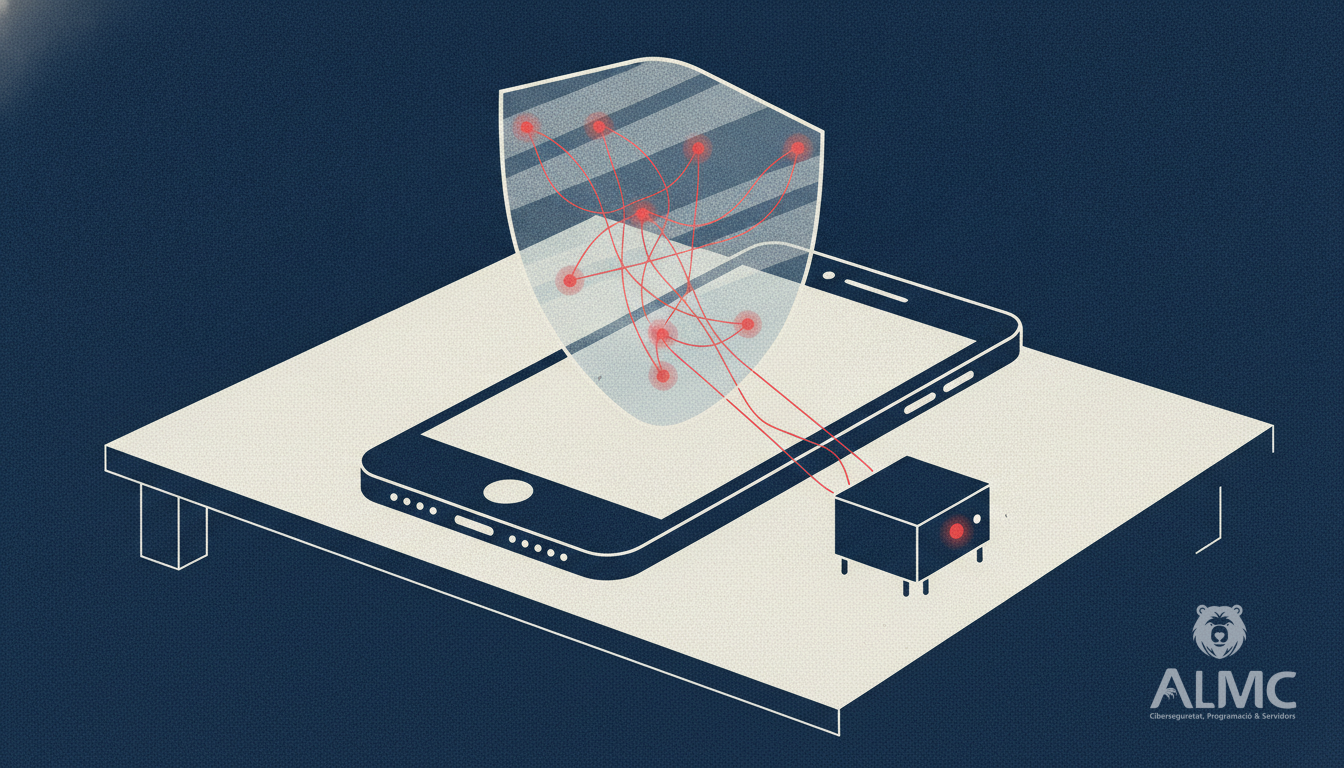
This is not a theoretical concern. Threat actors are actively targeting connected environments, and the number of attempted intrusions against IoT infrastructure keeps climbing year after year. For CISOs and IT managers, the question is no longer whether an incident will happen, but how far an attacker could move once inside.
Why IoT and OT convergence changes the risk equation
Operational technology (OT) used to live behind an air gap: physically isolated from IT networks. That separation has largely disappeared. Sensors, gateways and industrial controllers now share infrastructure with business systems, and IoT acts as the bridge between both worlds.
Headless devices make this worse. Many sensors have no management interface and no reliable mechanism for secure over-the-air updates. Changing a default password is not enough when the firmware ships with hard-coded credentials: the visible key changes, but the hidden one remains.
- A compromised sensor on the IT side can become the entry point to SCADA systems and industrial machinery.
- Lateral movement is often trivial when network segments are not properly isolated.
- Operational downtime and reputational damage push the real cost of a breach well beyond the initial remediation bill.
Industry research from IBM Security consistently places the average cost of a data breach in technically complex environments in the millions of euros, and IoT/OT incidents tend to sit at the upper end of that range.
Building security in from the first sprint
At ALMC, we approach mobile development for connected environments with a simple principle: security by design, not as a patch added at the end. That means treating the mobile app as part of the attack surface from day one, not as a cosmetic front end.
A defence-in-depth architecture for IoT typically includes:
- Multi-factor authentication (MFA) for every user who can command a device.
- Encrypted APIs between the app, the cloud and the device, so intercepted traffic is useless to an attacker.
- Automated PKI to inject cryptographic identities at the factory and rotate keys without manual intervention.
- Hardware root of trust through TPM or HSM modules, so each device can sign and verify independently of external software.
Encryption should operate at several layers, from device-to-device links using AES-128 up to key renewal schemes based on RSA. This layered approach means that breaking one layer does not expose the entire chain.
Microsegmentation and virtual patching
Network segmentation is one of the most effective controls available, and it is often underused. Placing IoT traffic in dedicated VLANs limits how far an attacker can travel after compromising a single node. Combined with an intrusion prevention system (IPS) acting as a virtual patch, it is possible to protect devices that will never receive a real firmware update.
This complements mobile device management (MDM) tools, which let IT teams control, wipe and update the smartphones and tablets used to operate the installation. In a Spanish context, where GDPR obligations apply to any personal data processed through these apps, MDM also helps enforce access policies and audit trails.
Choosing the right communication protocol
The protocol you select determines how much security each node can support without draining its battery or saturating the available bandwidth. There is no universal winner; the right choice depends on the deployment environment.
- WIZE operates in a dedicated 169 MHz band with strong penetration in basements and water metering. Its exposure is lower, but the key management ecosystem is smaller.
- LoRaWAN covers tens of kilometres and suits rural areas and smart city projects. As an open standard, it requires its own session key rotation strategy.
- NB-IoT leverages cellular infrastructure and offers robust authentication, at the cost of higher power consumption.
Each option imposes different constraints on the mobile app that manages it. A protocol with limited payload size, for example, may force the app to handle more logic locally, which increases the importance of secure storage and code obfuscation on the device itself.
What this means for your business
If you are planning an IoT project in Catalonia or anywhere in Spain, the mobile app is not a secondary deliverable. It is the interface through which your team, your clients and potentially your suppliers interact with physical infrastructure. Designing it with Zero Trust principles, encrypted communications and a clear identity model is what separates a resilient deployment from a vulnerable one.
At ALMC we develop custom mobile applications for iOS and Android that take your business to your customers' pockets, from the initial idea through to publication on the app stores. For IoT-driven companies, that journey includes the security architecture that keeps your sensors, your data and your operations out of reach of anyone who should not be there.
Related
- 10 Mobile App Ideas to Transform Your Business in 2025
- The Mobile App Boom: Why Your Business Needs a Custom App in 2025
- Monetising Mobile Apps: Key Business Models for 2025
- Chatbot IA
Put these ideas into practice
Talk to ALMC about a solution for your business. Explore your options or contact our team.