
Do hotels really need their own mobile app?
Do hotels really need their own mobile app?
Start with the question nobody asks firstWhen a hotel in Lleida, Tarragona or Barcelona approaches us about building an app, the conversation usually...
Start with the question nobody asks first
When a hotel in Lleida, Tarragona or Barcelona approaches us about building an app, the conversation usually opens with design, colours and features. The question that actually decides the project comes much earlier: which property management system (PMS) do you run today? A guest-facing app only creates real value when it talks to the software that already holds your reservations, room assignments and charges. Without that connection, your reception team ends up copying data from one screen to another, and guests see information that does not match reality.
So the honest answer to whether your hotel needs its own app is: it depends. It depends on your volume, on your PMS and on what you have already solved. A small property, or one that already covers check-in, information and orders through a well-built web app, probably does not need a native app at all. A chain, a boutique hotel with a high share of repeat guests, or a business with a PMS that exposes a usable API is a different story: there, a custom app can show a clear return.
Three different things people call a hotel app
Before requesting quotes, it helps to separate three products that are often confused under the same label:
- Booking apps. Used by travellers to search, compare and reserve accommodation. These belong to online travel agencies and metasearch engines, not to your property.
- Management software. The PMS and its surrounding tools, used by your team for reservations, rates, rooms, invoicing and channel distribution.
- Guest apps. The app your guest installs before or during the stay: direct booking, online check-in, digital key, service requests and communication with reception.
When a hotel says it wants an app, it almost always means the third one. And the success of that third one depends heavily on how it connects to the second.
What a guest app can actually do
A well-scoped guest app accompanies the customer from the moment they book until they leave. The most common modules are direct booking at your own rates and conditions, online check-in and check-out with data captured before arrival, a digital key to open the room, orders for the restaurant, room service, spa or parking, information about the hotel and the surrounding area, a chat channel with reception, and offers for returning guests.
You do not need all of it on day one. In our experience, a first release with two or three functions that are properly integrated works far better than a long feature list where half the screens are disconnected from your operations. You can then grow the app based on how guests actually use it.
The integration with the PMS is the whole project
The PMS is the operational heart of the hotel: reservations, rooms, guest profiles and charges all live there. An app that does not integrate with it forces someone to duplicate work, which is precisely what an app should eliminate. The pieces that normally need to synchronise are availability, rates and reservations in both directions; guest data and check-in status; room assignment, which in turn feeds the digital key; and charges for services consumed during the stay.
Before signing anything, ask your PMS provider a few direct questions. Does it offer an open API or an integration marketplace, and is that included or billed separately? Is there a sandbox environment where a developer can work without touching live data? Which entities can be read and which can be written? Are there existing connectors for your booking engine, payment gateway or lock hardware? If the answer is that integration is not possible, the honest advice is to say so early. In that case the better investment may be upgrading or replacing the PMS rather than building an app on top of a dead end.
Digital keys depend on hardware, not on software
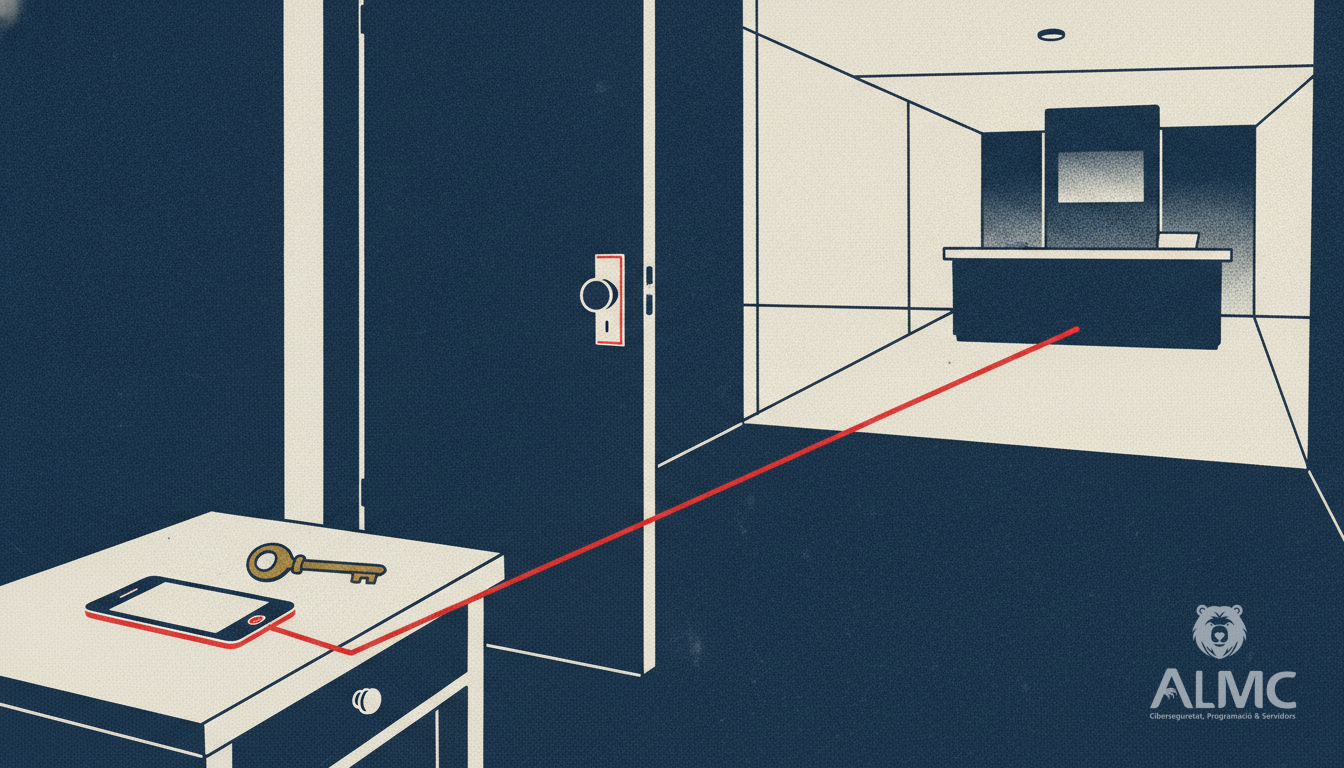
Opening a room with a phone is the feature that attracts the most attention, and also the one that constrains the project most, because it does not depend on the app alone. Locks vary widely: Bluetooth, NFC, PIN-code or hybrid models, and each family has its own integration path, installation requirements and maintenance regime. Budget for the hardware, the installation and the ongoing support before you promise digital keys to your guests.
Compliance in Spain: traveller registration and GDPR
In Spain, online check-in is not only a convenience. It helps properties comply with the traveller registration obligations introduced by Royal Decree 933/2021, which requires collecting and reporting guest data to the authorities. Capturing that information inside the app, with a clear consent flow, reduces friction at the desk and keeps records consistent. At the same time, any personal data the app handles falls under the GDPR, so you need a lawful basis, a retention policy and a processor agreement with your development partner. This is a point where a local agency familiar with Spanish and Catalan regulations saves considerable time.
How to measure whether it is working
An app is not a branding exercise, so define the metrics before launch. Track the share of direct bookings versus intermediary channels, the proportion of guests completing online check-in, revenue from services sold through the app, active usage during the stay and the volume of reception queries deflected to chat. If those numbers do not move after a few months, the problem is usually scope or integration, not the technology itself.
Where a custom build fits
Off-the-shelf guest apps are a reasonable starting point for small properties with standard needs. But hotels with particular workflows, several establishments, loyalty programmes or unusual PMS setups often reach the limits of a generic product quickly. That is where a custom mobile app for iOS and Android makes sense: built around your operations, integrated with your systems and published in the App Store and Google Play under your own brand. At ALMC.es we accompany hospitality businesses and startups across Catalonia from the first technical assessment through to publication and maintenance, so the app your guests download is one your team can genuinely rely on.
Related
- 10 Mobile App Ideas to Transform Your Business in 2025
- The Mobile App Boom: Why Your Business Needs a Custom App in 2025
- Monetising Mobile Apps: Key Business Models for 2025
- Chatbot IA
Put these ideas into practice
Talk to ALMC about a solution for your business. Explore your options or contact our team.