
Abuse Shield: Centralised Server Protection for Catalan SMEs
Abuse Shield: Centralised Server Protection for Catalan SMEs
Why scattered server defences failMost organisations in Barcelona, Lleida, Tarragona and Girona that run their own infrastructure have accumulated def...
Why scattered server defences fail
Most organisations in Barcelona, Lleida, Tarragona and Girona that run their own infrastructure have accumulated defences piece by piece. One server has fail2ban configured by hand, another relies on a firewall rule set that nobody has reviewed since it was deployed, and a third simply logs failed logins that no one reads. The result is predictable: when an attacker probes one machine, the others learn nothing.
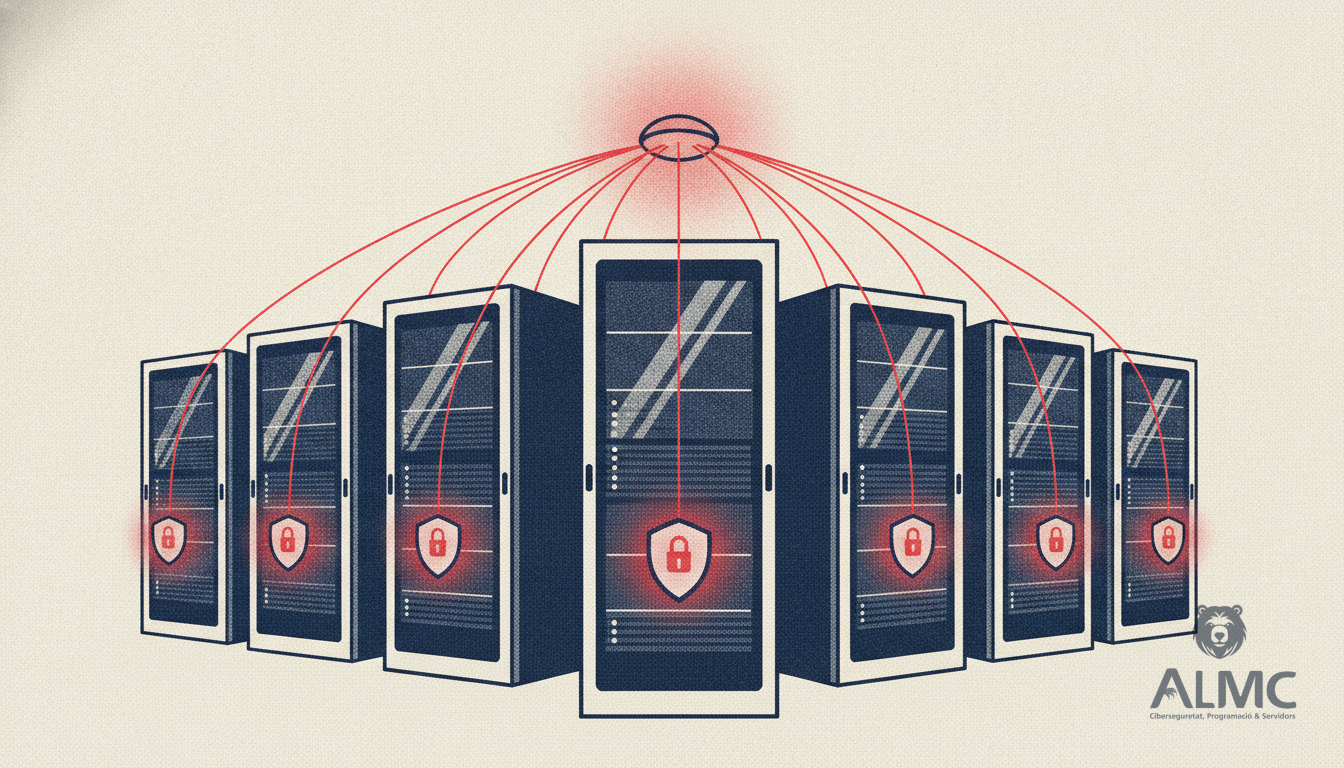
This fragmentation is exactly what sophisticated threat actors exploit. Recent research into state-aligned groups shows that many campaigns no longer aim for long-term persistence on a single host. Instead, they harvest credentials, VPN configurations and selected documents in a single quick operation, then move on. If the stolen credentials work against a second server in your estate, the attacker gains a foothold without ever needing to deploy a sophisticated implant.
What Abuse Shield changes
Abuse Shield is our managed answer to this problem. It centralises the protection of your servers around three pillars:
- Automatic IP blocking: malicious addresses are blocked as soon as they are detected, without waiting for an administrator to notice an alert.
- Managed fail2ban across multiple machines: the same policy is applied consistently to every server in your estate, whether it runs in a Lleida office, a Barcelona colocation facility or a public cloud region.
- A shared reputation feed: when one server identifies an abusive IP, every other server under your control learns about it immediately.
The principle is simple: your servers should behave as a single defensive organism, not as isolated islands. An attack against the weakest machine strengthens the protection of the strongest.
Built for administrators, hosting providers and SMEs
Abuse Shield is designed for three profiles that share the same underlying problem. System administrators gain a single console instead of a patchwork of SSH sessions and cron jobs. Hosting companies can offer consistent protection across hundreds of customer machines without multiplying operational overhead. And small and medium-sized enterprises with their own servers finally get enterprise-grade defence without hiring a dedicated security team.
For hosting providers in particular, the shared reputation feed is a commercial advantage. A customer whose server is attacked benefits from intelligence gathered across the entire fleet, which is difficult to replicate in-house.
Compliance and data protection in the EU context
Any security tool that processes connection logs and IP addresses must be designed with the GDPR in mind. Abuse Shield is built for European deployments: log retention is limited to what is necessary for detection, access to reputation data is controlled, and the processing of personal data such as IP addresses follows the principles of minimisation and purpose limitation. For organisations in Catalonia handling client data under Spanish data protection law, this matters as much as the technical efficacy of the blocking itself.
From reactive to proactive defence
The traditional model of server security is reactive: an administrator reviews logs after an incident, blocks an address manually, and hopes the attacker does not return from a different one. Abuse Shield inverts that logic. Blocking happens automatically, reputation is shared, and the administrator's time is spent on architecture and improvement rather than on repetitive firefighting.
This shift is especially relevant against campaigns that rely on rapid credential harvesting. If a stolen password is used from an address already flagged by another server in your fleet, the attempt is stopped before it reaches the authentication layer.
Getting started
Deploying Abuse Shield does not require ripping out your existing stack. It integrates with the fail2ban instances you already run and extends their reach across machines. Whether you manage two servers or two hundred, the objective is the same: a single, coherent defensive posture that grows stronger with every machine you add.
If your organisation operates servers in Catalonia or anywhere in Spain and wants to stop treating each machine as a separate security problem, Abuse Shield is the natural next step.
Related
- How to Harden Your Servers with Fail2ban and IP Reputation Feeds
- Fail2ban: Your First Line of Defense Against Unauthorized Server Access
- Critical libssh2 flaw: urgent patch for SSH servers
- Desarrollo web
Put these ideas into practice
Talk to ALMC about a solution for your business. Explore your options or contact our team.