
IoT Security: When Your Fridge Becomes the Attack Surface
IoT Security: When Your Fridge Becomes the Attack Surface
A cold chain that answers to the internetOver a few weeks in late 2026, unknown attackers reached into the cooling systems of hundreds of supermarkets...
A cold chain that answers to the internet
Over a few weeks in late 2026, unknown attackers reached into the cooling systems of hundreds of supermarkets across France, Belgium, Luxembourg, Sweden, Ireland, the Netherlands, Estonia and Finland. They did not steal customer data or demand a ransom. They simply pushed the temperature of freezers and cold rooms upwards, in some cases forcing defrost cycles to run far longer than intended so that alarms would stay quiet. A French blood bank's cold storage was also touched, and a technician on duty caught the anomaly before any blood products were lost. No group claimed responsibility, which points more towards sabotage than profit.
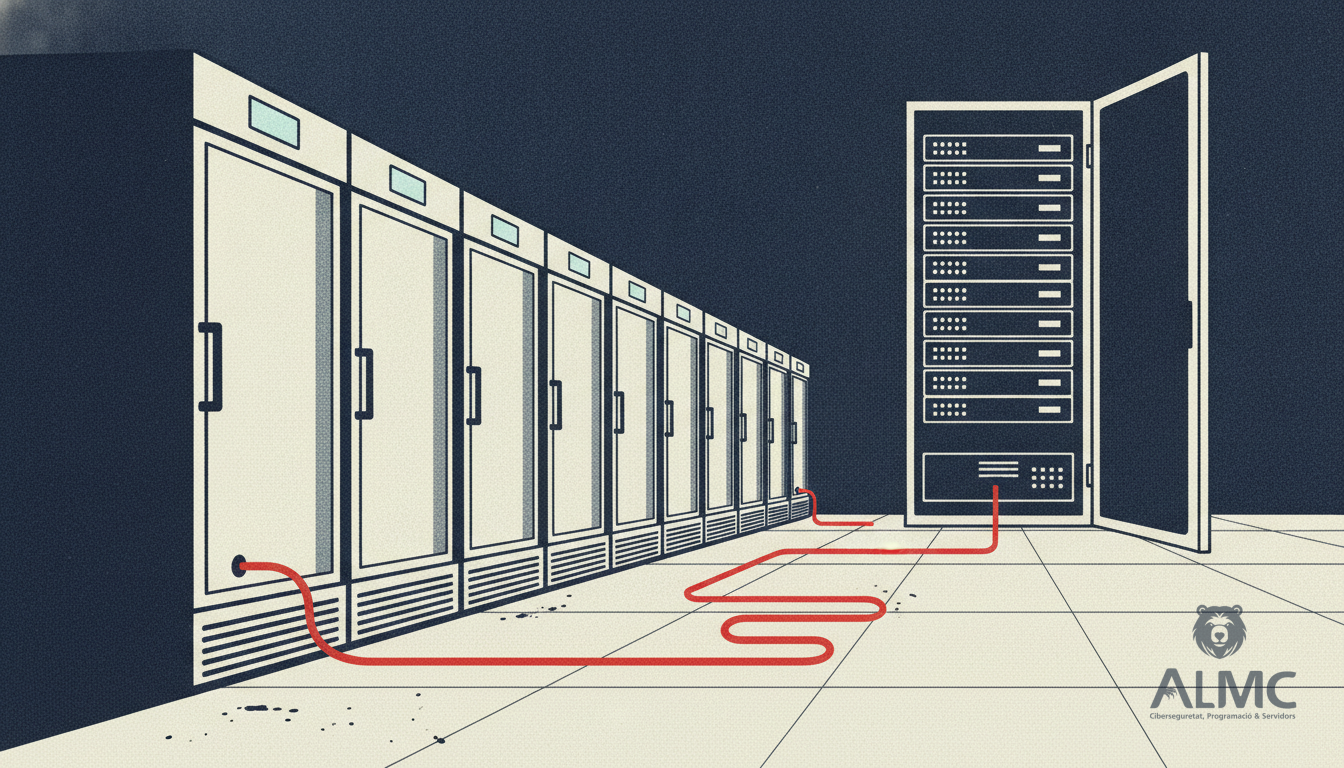
For anyone running infrastructure in Catalonia, this is not a distant curiosity. The same ingredients that made those incidents possible — internet-facing controllers, factory credentials nobody changed, firmware without vendor support, and no out-of-hours monitoring — sit inside plenty of small and mid-sized companies in Barcelona, Lleida, Tarragona and Girona. The lesson is not really about fridges. It is about the perimeter you have quietly accumulated.
Every connected device is a server you forgot to secure
A commercial fridge is no longer a compressor and a thermostat. It carries a controller with a network connection so a technician can adjust parameters remotely and receive alerts. That is convenient, and it is also an entry point. The same pattern repeats across warehouses, clinics, laboratories, hotels and industrial plants: sensors, PLCs, cameras, access controllers and building-management gateways, all reachable over the network, all rarely reviewed by anyone with a security remit.
When investigators looked at the European incidents, the weaknesses were ordinary rather than exotic:
- Default or unchanged credentials on devices that had been installed years earlier.
- Outdated or end-of-life firmware with no vendor patches forthcoming.
- No supervision during the night, giving attackers hours to work undisturbed.
- Access paths inherited from a supplier or integrator, with no independent monitoring on the client side.
None of this requires an advanced adversary. It requires patience and a scan.
Why the network layer is where you win
You cannot patch a freezer controller that the manufacturer abandoned, and you cannot always convince a facilities team to replace hardware this quarter. What you can do is control who talks to it, from where, and how often. Most of these intrusions involve repeated connection attempts from a relatively small set of addresses, probing for open ports and weak logins before anything is altered. That behaviour is visible at the network edge, long before the temperature starts to climb.
This is the reasoning behind Abuse Shield, the service we run at ALMC.es. Rather than treating each machine as an island, it centralises protection across your estate:
- Automatic IP blocking for addresses that repeatedly fail authentication or behave maliciously, applied consistently on every protected host.
- Managed fail2ban across multiple machines, so you are not hand-editing jails and filters on each server and hoping the configuration stays in sync.
- A shared IP reputation feed between all your servers, so an address that hammers one machine is refused by the rest before it tries.
The practical effect is that a probe against a single exposed endpoint hardens the whole fleet within minutes. For hosting providers managing dozens of customer servers, or for a company with a handful of VPS instances spread across providers, that shared memory is the difference between isolated defence and a collective immune system.
Bringing operational technology into the same conversation
The refrigeration incidents also expose an organisational gap. Facilities teams buy and maintain the cooling equipment; IT teams own the network; nobody owns the intersection. A sensible starting point for Spanish and Catalan organisations is to inventory every device with an IP address, including the ones installed by contractors, and to decide explicitly which of them should be reachable from the public internet at all. Where remote access is genuinely needed, route it through a controlled jump point rather than exposing the controller directly.
Alongside that, keep the basics honest: change factory passwords on day one, track firmware end-of-life dates, and make sure alerts reach a human at three in the morning. Under GDPR, temperature logs and access records for cold storage often count as personal data processing when they relate to staff or patients, so monitoring gaps are a compliance question as well as an operational one.
Start with the servers you already control
You will not fix every legacy controller this month. You can, however, make sure that the servers and gateways you do manage stop tolerating abusive traffic. A managed, centralised approach to IP reputation and automatic blocking gives you a defensible baseline, and it scales from a single VPS to a hosting fleet without rewriting your playbook each time you add a machine. In a landscape where the attack surface now includes the cold room, that baseline is no longer optional.
Related
- How to Harden Your Servers with Fail2ban and IP Reputation Feeds
- Fail2ban: Your First Line of Defense Against Unauthorized Server Access
- Critical libssh2 flaw: urgent patch for SSH servers
- Desarrollo web
Put these ideas into practice
Talk to ALMC about a solution for your business. Explore your options or contact our team.