
Your online store can't afford a 'try again later'
Your online store can't afford a 'try again later'
The day your store goes down is never a quiet TuesdayThere is a world of difference between a store that loads slowly and a store that simply is not t...
The day your store goes down is never a quiet Tuesday
There is a world of difference between a store that loads slowly and a store that simply is not there. The first costs you conversion; the second costs you the order, the review and, more often than you would like, the customer. And it almost always happens on the worst possible day: the morning a campaign goes live, the minute a newsletter lands, the first hour of Black Friday.
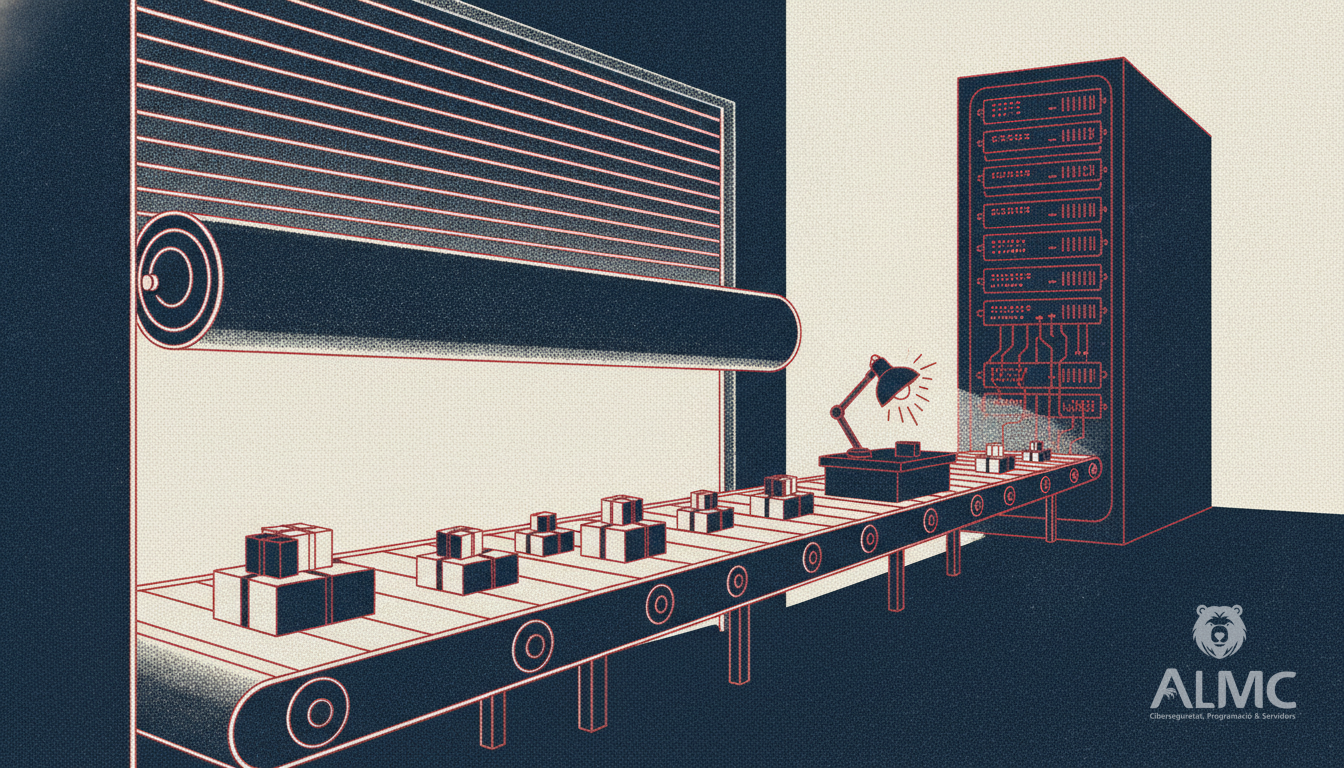
At ALMC.es we build and run online stores for shops and brands across Catalonia — Barcelona, Lleida, Tarragona, Girona — and we have learned that the technical layer nobody wants to talk about at round tables is precisely the one that decides whether a campaign succeeds or ends on an error screen.
Where your store lives shapes how it behaves
When hosting is chosen purely on price, your store usually ends up sharing a machine with hundreds of projects you do not control. One noisy neighbour with a traffic spike or a badly written query is enough to slow your catalogue down, and you will not have changed a single line of code. Ask the provider why, and often they cannot tell you either: the infrastructure is not theirs, they rent it.
This is why we start every ecommerce project by looking at the foundation, not the template. A well-dimensioned environment — the right disk type, enough memory, a current PHP version, a tuned database and a sensible cache layer in front — can cut response times dramatically without touching the development. It is the kind of improvement that never shows up in a design review but shows up in conversion rate and in what each paid visit actually costs you.
PrestaShop, WooCommerce and the stack around them
We work with the two platforms that fit most Spanish and Catalan merchants: PrestaShop and WooCommerce. Both are excellent when they are properly configured, and both become fragile when they are treated as a plugin collection. Our approach is to build a store that genuinely sells:
- Platform fit: PrestaShop when the catalogue and back-office logic are complex; WooCommerce when content, SEO and editorial flexibility matter more.
- Conversion optimisation: checkout flows, product pages, search, mobile performance and payment methods adapted to Spanish buyers — cards, Bizum, transfer and, where relevant, financing.
- Integration: ERP, invoicing, logistics operators, stock synchronisation and electronic invoicing compliant with Spanish requirements.
- Measurement: analytics and consent configured so that the data you use to decide is both useful and lawful under GDPR.
None of that works on top of an unstable server. Platform choice and infrastructure are the same decision seen from two angles.
Speed is an infrastructure problem before it is a design problem
In an online store, every extra tenth of a second in response time is felt at the cart. Part of that time depends on the machine serving the site, not on how many images the homepage has. When we audit a slow store, we measure first and touch nothing until we understand where the time is going. In many cases the same code, moved to a properly sized and tuned environment, responds in half the time.
That is why we do not sell closed hosting plans. A marketplace with tens of thousands of SKUs and a niche brand that sells in four campaigns a year do not need the same thing. We dimension dedicated, cloud or hybrid environments with you and adjust them as the project grows, with planned migrations, agreed windows, prior testing and a rollback plan so that changing provider does not become the incident you were trying to avoid.
Support that answers at 23:40 on a Friday
Anyone who has managed an online store knows that night: it is 23:40 on a Friday, the payment gateway is returning errors and the provider's chat replies with a help article. That is where you see the difference between support that exists to close tickets and support that exists to solve problems. Stores do not close and campaigns do not wait, so technical cover needs to be continuous, with people who know your setup and can act on the machine your store runs on.
Security and GDPR are business requirements
An online store handles names, addresses, purchase histories and, often, billing data. That makes security a commercial obligation, not a technical extra. Under GDPR, you need to know where personal data is stored, who can access it and how it is backed up. A store built on infrastructure you do not understand is a compliance risk as much as a performance one.
In practice this means encrypted connections, access control, tested backups, a clear data processing agreement with your provider and a consent setup that actually reflects what your analytics and marketing tools do. It is less glamorous than a new homepage, and considerably cheaper than a breach.
What to ask before you trust a store to anyone
Whether you are launching your first ecommerce project in Lleida or replatforming a brand that already sells across Spain, a few questions separate a serious partner from a reseller:
- Where exactly will the store be hosted, and who operates that infrastructure?
- What happens at 2 a.m. if the database stops responding?
- How will migration be planned, and what is the rollback plan?
- Who is responsible for backups, updates and security patching?
- Can the environment scale for a campaign without a rebuild?
A store that sells is not the one with the prettiest theme. It is the one that stays up, loads fast, converts and keeps customer data safe — on the quiet Tuesdays and on the busiest Friday of the year.
Related
- WooCommerce vs PrestaShop: Which Ecommerce Platform Wins in 2025?
- CRO for Ecommerce: Turning WooCommerce and PrestaShop Templates into Sales Engines
- Agentic Commerce: How AI Agents Are Rewriting the Rules of Online Shopping
- Desarrollo web
Put these ideas into practice
Talk to ALMC about a solution for your business. Explore your options or contact our team.