
Mobile apps for events: from idea to app store
Mobile apps for events: from idea to app store
Start with the problem, not the technologyWhen an organiser approaches us about an event, the conversation rarely begins with "we want an app". It beg...
Start with the problem, not the technology
When an organiser approaches us about an event, the conversation rarely begins with "we want an app". It begins with a concrete worry: the queue at the door, a vote that nobody trusts, a Q&A session where the microphone never reaches anyone. That is the right way to frame it. A mobile app earns its place when it solves a specific moment: registration, access, participation during sessions, contact between exhibitors and visitors, or the data you review afterwards. At ALMC.es we build bespoke mobile apps for iOS and Android, and we always start by mapping those moments before writing a line of code.
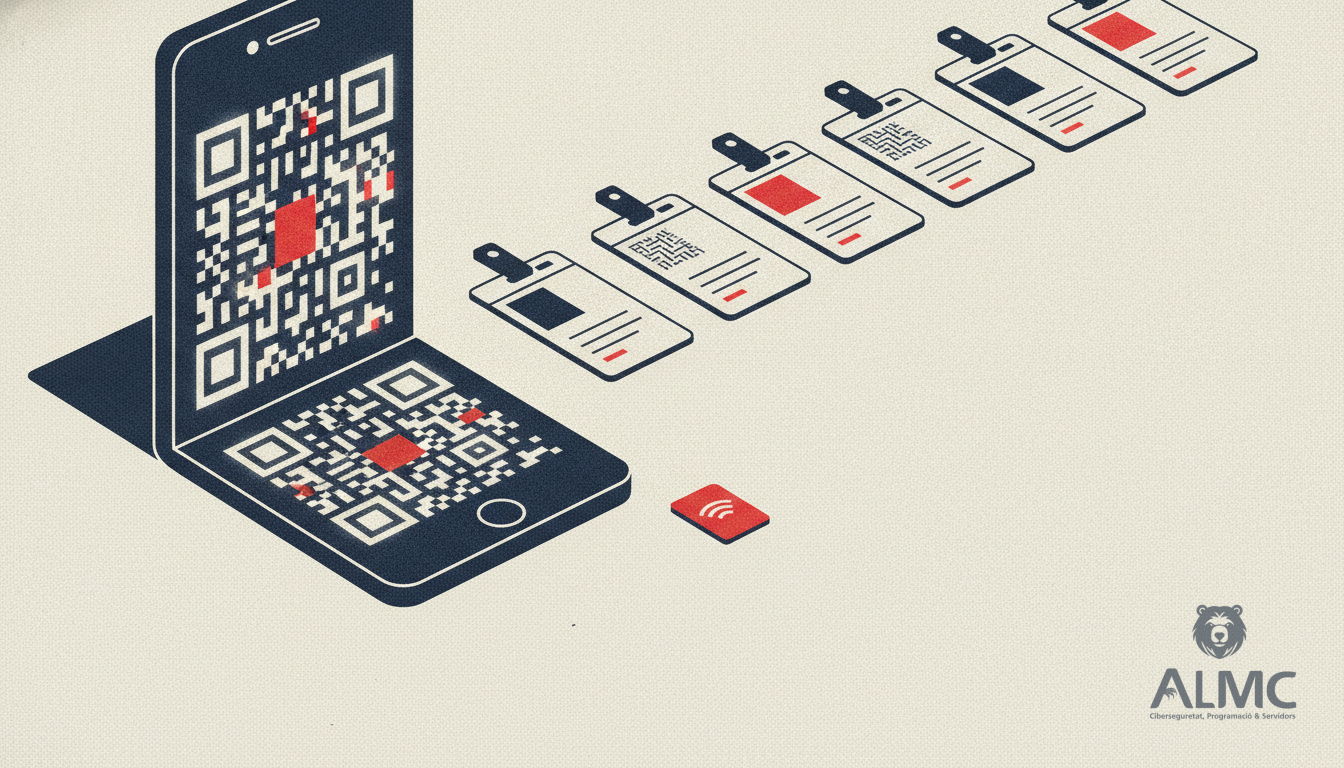
This article walks through the journey of an attendee, from the moment they register to the report you read a week later, and explains where a custom app adds value and where a simpler solution is enough.
Before the event: registration and accreditation
Everything begins with registration. The data collected at sign-up generates each attendee's accreditation, the credential that identifies them at the entrance, in sessions and at stands. Two formats dominate the market:
- QR code accreditation: sent by email or printed on the badge. It is the most affordable option and demands the least logistics.
- NFC accreditation: a chip embedded in a card, wristband or badge, read by holding it a few centimetres away. It gives the event a more technological feel, but raises costs because the supports must be produced with the chip.
The two are not mutually exclusive. A single event can use QR for most attendees and NFC for a specific profile or a restricted area. A well-designed app handles both from the same backend, so the organiser manages one system rather than two.
At the door: access control and check-in
The entrance is the moment that worries every organiser, because it is where queues form and where a failure is immediately visible. An access control system reads the credential, checks that it is valid for that event, that day or that room, and logs the entry. The organiser then knows at any moment how many people are inside and who has arrived.
There is one question worth asking any provider: what happens if the venue loses its internet connection? Coverage often fails at peak hour, precisely when hundreds of people are using their phones at once. The systems we develop validate offline on the device itself and synchronise records once the network returns, so the door never stops moving. For a congress in Barcelona or a trade fair in Lleida, that resilience is not a luxury; it is the difference between a smooth opening and a public incident.
During the sessions: voting and questions to the speaker
Once attendees are inside, the challenge shifts to participation. Two tools complement each other particularly well.
Live voting and televoting. Useful for on-the-spot surveys, award ceremonies, assemblies or committees. The attendee scans a QR code with their phone camera or enters the event PIN and votes without installing anything or renting handsets. Results are projected in real time, in the room or by videoconference if the event is online. When the vote must be more secure, for instance at an awards ceremony or a formal assembly, we use a "one PIN, one vote" model: single-use codes are generated and printed, handed to each attendee, so each person votes exactly once.
Questions to the speaker. The classic roving microphone has two problems: many people do not dare to speak in public, and the Q&A slot fills with interventions that add little. A mobile channel lets attendees submit questions from their seat, moderators group and prioritise them, and the speaker answers the ones the room actually cares about. It is a small change that transforms the quality of the discussion.
Do you always need your own app?
No. This is where honesty matters. Some events run perfectly well with a QR code, a web form and a screen. A native app makes sense when you need offline access control, push notifications, a persistent community, or an experience that must work reliably on the attendee's phone over several days. The decision should follow the moments you need to solve, not the feature list of a platform.
For companies and startups beyond the events world, the same logic applies. A bespoke app is justified when it brings your service into your customer's pocket in a way a website cannot: recurring bookings, loyalty, field teams, or a workflow that must work without connectivity. We take the project from the initial idea through to publication in the App Store and Google Play, including GDPR-compliant data handling, which in Spain and Catalonia means clear consent, data minimisation and a documented retention policy.
After the event: what you measure
The final moment is the one most often forgotten. A well-instrumented app tells you how many people checked in, which sessions filled the room, how many questions were submitted and which exhibitors received the most visits. That data turns the next edition from a guess into a plan. It also justifies the investment to sponsors and public administrations, who increasingly ask for evidence of impact.
Where to begin
Write down the three moments that worry you most. If registration, access and participation are on that list, a custom mobile app built for iOS and Android is probably the shortest path. If only one of them is, a lighter piece of software may be enough. Either way, the starting point is the same: define the problem in plain language, then choose the technology that solves it. That is how we work at ALMC.es, from our base in Lleida, for organisations across Catalonia and the rest of Spain.
Related
- 10 Mobile App Ideas to Transform Your Business in 2025
- The Mobile App Boom: Why Your Business Needs a Custom App in 2025
- Monetising Mobile Apps: Key Business Models for 2025
- Chatbot IA
Put these ideas into practice
Talk to ALMC about a solution for your business. Explore your options or contact our team.