
Defender as a Privilege Escalation Lever: Lessons for Server Security
Defender as a Privilege Escalation Lever: Lessons for Server Security
When the Bodyguard Becomes the WeaponOver the past few months, a quiet but significant story has been unfolding around Microsoft Defender. It is not s...
When the Bodyguard Becomes the Weapon
Over the past few months, a quiet but significant story has been unfolding around Microsoft Defender. It is not simply that three separate vulnerabilities have appeared in a security product. It is that RoguePlanet, ShieldBreak and, most recently, ShieldCrash reveal a shift in how attackers approach one of the most privileged components of Windows. Instead of hunting for a kernel primitive or an exposed SYSTEM service, they try to persuade Defender itself to perform an operation on their behalf that they could never carry out alone.
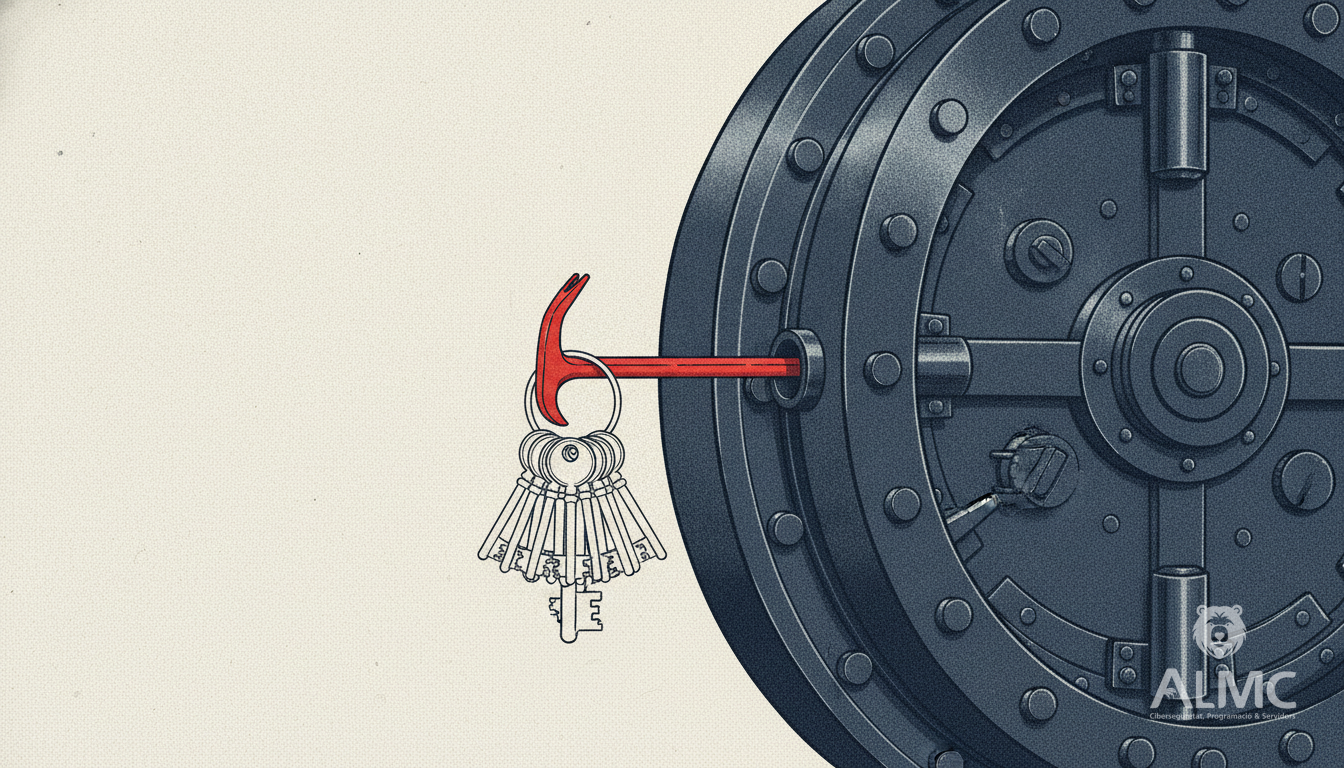
This is a pattern that every systems administrator, hosting provider and SME running its own servers in Spain should understand, because the same logic applies far beyond Windows.
RoguePlanet and the Confused Deputy Problem
The story began with RoguePlanet, tracked as CVE-2026-50656, an elevation-of-privilege flaw in the Microsoft Malware Protection Engine. Microsoft addressed it with engine version 1.1.26060.3008, released on 30 June 2026, and its own documentation identifies that update as the fix. A public proof of concept showed that an unprivileged local user could reach a SYSTEM shell, although reliability varied from machine to machine because the bug was a race condition.
The real lesson is not the specific bug. Defender runs code with elevated privileges and continuously processes files that a normal user can create or modify. Any routine operation — opening, validating, resolving or cleaning a file — can become an escalation primitive if there is a window in which the attacker can change the true identity of the object Defender believes it is handling.
Conceptually, the sequence looks like this: Defender opens a path controlled by the attacker, validates the object at that path, and then performs a privileged operation. If the attacker can swap the underlying object between validation and use, the privileged operation ends up acting on something else entirely. The attacker never needs to steal the SYSTEM token; they only need SYSTEM to act on an object of their choosing. It is a textbook combination of name resolution, race conditions and confused-deputy privilege abuse, applied to an antivirus engine.
ShieldBreak: Using the Scanner's Own Workflow
Microsoft closed that route with the engine update, but the patch did not remove the underlying attack surface. Shortly afterwards, ShieldBreak appeared as CVE-2026-69414, and it is considerably more sophisticated. Its public proof of concept runs to roughly 1,400 lines and combines several internal Windows interfaces and subsystems: the Defender client library, the Malware Protection Engine APIs, Cloud Files, the Common Log File System, the Object Manager and Windows Error Reporting. It dynamically resolves internal engine functions to start a scan and then reach into the detection and remediation flow.
The crucial detail is that ShieldBreak does not simply try to execute code inside Defender. It abuses the legitimate scanning workflow as the mechanism that carries the attacker into a privileged operation. One of the most interesting components is Cloud Files, the Windows infrastructure that lets storage providers implement placeholder files and on-demand hydration. When Defender inspects such an object, it can trigger a data request to the provider. By registering a Cloud Files callback, the attacker can respond to specific requests with content that becomes part of the attack.
In other words, the trusted scanner is invited to fetch data from a source the attacker controls, and that data is then processed with high privileges. The scanner becomes both the entry point and the delivery mechanism.
Why This Matters for Your Infrastructure
It is tempting to file these incidents under "Windows problem" and move on. That would be a mistake. The pattern they expose is universal, and it affects the servers that businesses across Barcelona, Lleida, Tarragona and Girona rely on every day.
- Trusted processes are high-value targets. Any daemon, agent or service that runs with elevated rights and touches user-controlled input is a potential confused deputy. That includes backup agents, monitoring tools, file sync clients and, of course, antivirus engines.
- Race conditions are not exotic. The window between checking an object and using it is often milliseconds wide, but automated tooling can hit it repeatedly. If your threat model ignores timing attacks, it is incomplete.
- Attackers follow the privileges, not the product. They will abuse whatever runs as root or SYSTEM, regardless of whether it is a security tool. A compromised security agent is worse than no agent, because it is trusted by default.
- Patch discipline buys time, not immunity. Microsoft fixed RoguePlanet, yet ShieldBreak followed. The surface remains attractive as long as the architecture allows privileged processes to consume untrusted data.
Defence in Depth for Server Fleets
So what should an administrator actually do? The answer is not to remove antivirus or disable security tooling. It is to assume that any privileged component can be turned against you and to layer controls accordingly.
First, reduce the blast radius. Run services with the least privilege they genuinely need, segment workloads, and avoid granting root or SYSTEM where a dedicated account would suffice. On Linux fleets, that means careful use of systemd sandboxing, capabilities and mandatory access control.
Second, control what reaches your servers. Most attacks of this kind require the attacker to place or influence a file, a path or a callback. Restricting inbound access, validating uploads and monitoring unusual file activity on sensitive directories all raise the cost of the attack.
Third, and this is where many organisations are weakest, treat network-level abuse as a first-class concern. Privilege escalation is often the second stage of an intrusion; the first stage is usually an exposed service being probed, brute-forced or exploited from a malicious IP address. If you are not blocking those sources automatically, you are giving attackers unlimited attempts to find the weakness that lets them in.
This is precisely the gap that ALMC's Abuse Shield is designed to close. It centralises protection across your servers, automatically blocking malicious IP addresses, managing fail2ban across multiple machines and sharing an IP reputation feed between all of them. When one server in your fleet identifies an abusive source, the others learn about it immediately. For hosting companies and SMEs running their own infrastructure, that shared intelligence turns isolated defences into a coordinated one, and it removes the manual work of keeping fail2ban rules consistent across every host.
The Broader Takeaway
RoguePlanet, ShieldBreak and ShieldCrash are a reminder that security is not a product you install but a posture you maintain. The most dangerous vulnerabilities are not always in obscure code; sometimes they are in the trusted tools we deploy precisely because we believe they protect us. Whether you run Windows servers, Linux fleets or a hybrid estate, the principles are the same: minimise privilege, control input, monitor behaviour and block hostile sources before they get a chance to try.
Attackers will keep looking for the lever that turns a defender into a weapon. Your job is to make sure that lever is hard to reach, and that when someone does reach for it, the rest of your infrastructure is already watching.
Related
- How to Harden Your Servers with Fail2ban and IP Reputation Feeds
- Fail2ban: Your First Line of Defense Against Unauthorized Server Access
- Critical libssh2 flaw: urgent patch for SSH servers
- Desarrollo web
Put these ideas into practice
Talk to ALMC about a solution for your business. Explore your options or contact our team.