
Server Security Beyond the Endpoint: Centralised IP Reputation
Server Security Beyond the Endpoint: Centralised IP Reputation
Defending servers one by one is a losing habitMost organisations with their own infrastructure have a familiar story. A server gets hammered by SSH br...
Defending servers one by one is a losing habit
Most organisations with their own infrastructure have a familiar story. A server gets hammered by SSH brute-force attempts, someone installs fail2ban, tunes a few jails, and the noise stops. Then a second server appears, then a VPS for a staging environment, then a client machine hosted in a Barcelona data centre. Each one gets its own copy of the configuration, its own ban list, its own idea of who the bad guys are. Six months later nobody is entirely sure which rules are active where, and the attacker who was blocked on one machine is quietly probing the next.
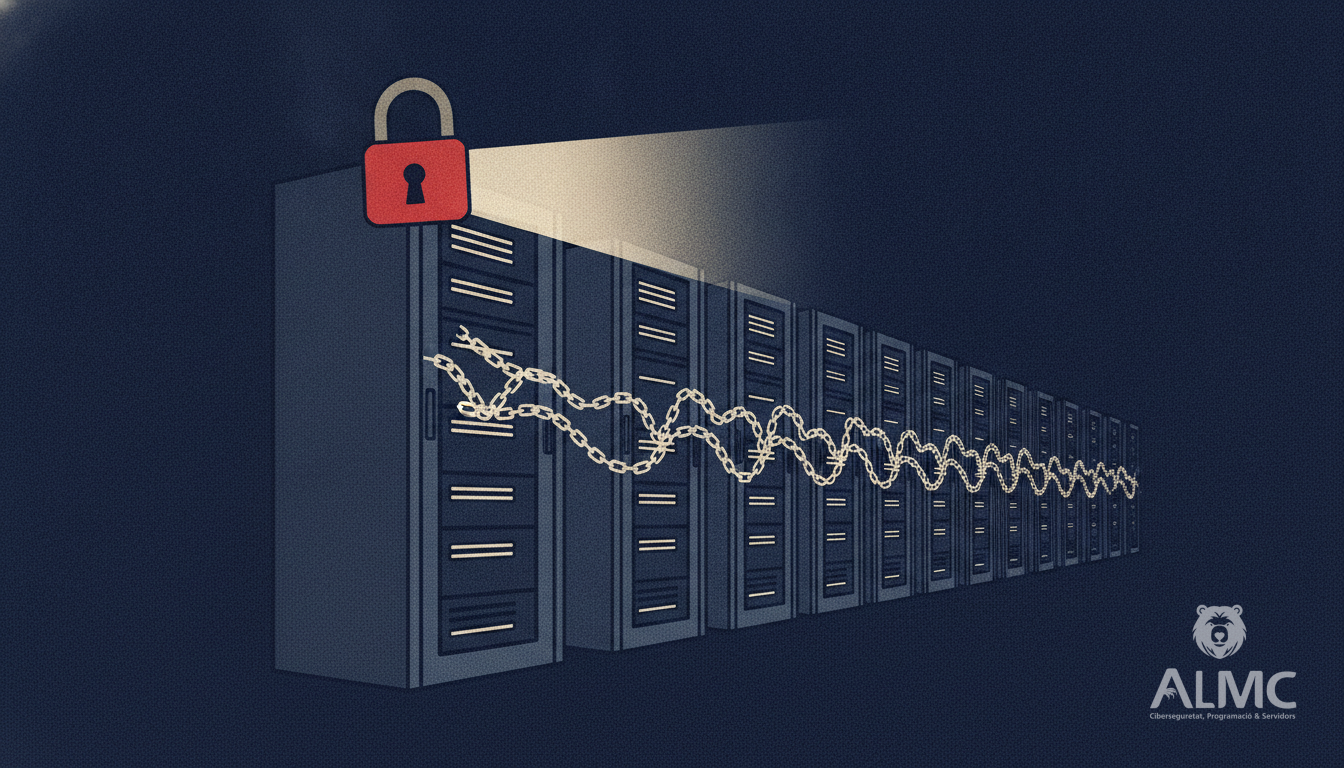
This is the core problem with treating server security as a per-machine exercise. The threats are not per-machine. Bots and credential-stuffing campaigns rotate across whole ranges of addresses, testing every door they can reach. If your defences are siloed, each server has to learn the same lesson from scratch, and every gap between them is an opportunity.
What Abuse Shield changes about the model
Abuse Shield, the protection service we run at ALMC.es, starts from a different premise: protection should be shared, not duplicated. It centralises server defence across all your machines and turns isolated fail2ban instances into a coordinated network. Concretely, it does three things well.
- Automatic blocking of malicious IPs. Addresses that misbehave are detected and blocked without waiting for an administrator to notice. The response is immediate rather than reactive.
- Managed fail2ban across multiple machines. Instead of hand-editing jails on each host, the configuration is managed centrally and applied consistently across the fleet, so every server follows the same policy.
- A shared IP reputation feed. When one server identifies an abusive address, that intelligence propagates to the rest. A block learned on a web server in Lleida protects a mail server in Girona before the attacker even reaches it.
The value is cumulative. Each additional machine you add to the network makes the whole network smarter, not just bigger.
Why this matters for hosting companies and SMEs
The audience for this kind of protection is broader than it first appears. System administrators managing a mixed estate of physical and virtual servers feel the pain of configuration drift most acutely. Hosting providers face it at scale: hundreds of tenants, each with their own attack surface, and a reputation to protect when one compromised account starts sending spam or scanning the neighbourhood. And small and medium businesses with their own servers, perhaps a CRM, an ERP and a couple of web applications, often have exactly one person who knows how the firewall works, and that person is on holiday when it matters.
For all three groups, the shared feed is the decisive advantage. An attack campaign rarely targets a single host. It sweeps. Centralised reputation means the sweep is detected at the first contact and neutralised everywhere else, which is precisely the behaviour you want when you cannot afford to monitor each machine around the clock.
Compliance and the GDPR angle
In Spain and across the EU, server logs and IP addresses are personal data under the GDPR. That has practical consequences for how you handle blocking and retention. A centralised system makes this easier to govern, not harder: you can define one retention policy, one set of access controls and one audit trail for the whole estate, rather than hoping each administrator applies the same rules locally. Documenting that malicious IPs are processed for security purposes, under the legitimate interest basis, becomes a single exercise instead of a scattered one. It is a quieter benefit than the automatic blocking, but for any organisation that has faced an audit, it is often the one that matters.
Where it fits in a modern security posture
It is worth being clear about scope. Abuse Shield is not a replacement for identity-focused security work, endpoint detection or a considered patching regime. Modern attacks increasingly target identities, cloud permissions and trust relationships rather than individual processes, and no IP-level tool addresses that. What a shared reputation feed does is remove a large volume of background noise: the automated scanning, the brute-force attempts, the credential stuffing that fills logs and distracts the people who should be looking at the more interesting signals.
Think of it as raising the floor. When routine abuse is blocked automatically and consistently across every server, your team spends less time firefighting and more time on the things that genuinely need human judgement. For a hosting company in Tarragona or an SME in Lleida with a small IT team, that shift in attention is often worth more than any single feature.
Getting started without a big project
The appeal of a managed approach is that it does not demand a migration. You keep your servers where they are; the protection layer sits across them. Start with the machines that face the internet most directly, web and mail front ends, then extend to internal hosts as confidence grows. Review the blocked-address reports periodically, because they are also a useful signal of what is targeting you and from where.
Server security has become a fleet problem, not a machine problem. Treating it that way, with managed fail2ban and a reputation feed shared across every host, is a small change in architecture with a disproportionate effect on your exposure.
Related
- How to Harden Your Servers with Fail2ban and IP Reputation Feeds
- Fail2ban: Your First Line of Defense Against Unauthorized Server Access
- Critical libssh2 flaw: urgent patch for SSH servers
- Desarrollo web
Put these ideas into practice
Talk to ALMC about a solution for your business. Explore your options or contact our team.