
OAuth Token Leak: Supply Chain Lessons for Server Security
OAuth Token Leak: Supply Chain Lessons for Server Security
When a browser extension becomes the weakest linkIn September 2026, security researchers uncovered a supply chain incident involving a popular browser...
When a browser extension becomes the weakest link
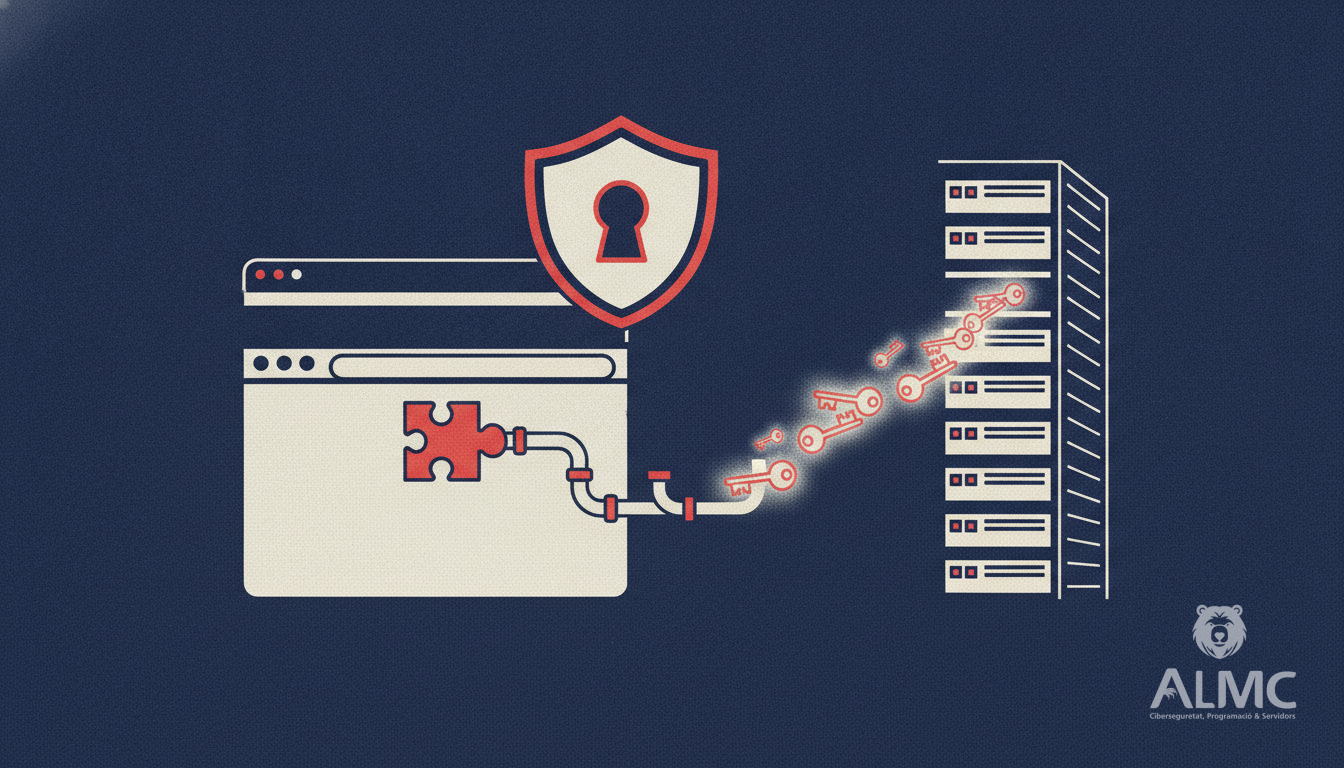
In September 2026, security researchers uncovered a supply chain incident involving a popular browser extension for a well-known streaming platform. The add-on, distributed through the official Chrome Web Store and Mozilla Add-ons, was silently forwarding session credentials to infrastructure controlled by its operator. The affected user base ran into the tens of thousands, and the exposure was not a simple data leak: the stolen material consisted of OAuth tokens, which behave like bearer credentials. Whoever holds them can act as the legitimate user without knowing the password or passing a second factor.
For system administrators, hosting companies and SMEs running their own servers in Barcelona, Lleida, Tarragona or Girona, the episode is a reminder that perimeter security no longer stops at the firewall. The attack surface now includes the browsers, extensions and third-party tools that employees use every day. And when those tools touch authenticated sessions, the consequences can be as severe as a compromised server.
Why OAuth tokens are a high-value target
OAuth tokens are not mere internal references. They are credentials that grant access to an authenticated session. In the Twitch case, abuse ranged from reading and sending private messages to posting in chat or modifying account settings. No password was required, and two-factor authentication offered no protection because the token already represented a completed login.
The technical detail that made this incident particularly dangerous was how the token was exfiltrated. From version 85.x, the extension appended the token as an &auth= query parameter during network-level redirects to proxy servers controlled by the operator. Because the token travelled inside a URL, it could be stored in clear text in proxy logs. If those logs are later accessed improperly or leaked, the exposure multiplies. The forwarding applied to almost any channel the user opened, with a hardcoded exception list of ten channels. Later versions added a Channels with restrictions setting, but this only created an illusion of control: the underlying exfiltration remained.
Earlier versions had already experimented with similar data handling, sending tokens via POST requests to an operator endpoint and even defining backup endpoints on third-party hosting platforms. A fix arrived in Firefox version 85.8.7, which removed the token forwarding, and a Chrome patch was announced. However, updating or disabling the extension only stops the leak from that moment on; it does not invalidate tokens that have already left.
Immediate response: revoke, rotate, review
If your organisation uses this extension, or any similar one with access to authenticated sessions, the response should be immediate:
- Uninstall or disable the extension on all managed devices.
- Update Firefox to at least version 85.8.7, and apply the Chrome patch as soon as it is available.
- Close all active sessions from the account settings and re-authenticate to force session rotation.
- Review recent activity, private messages and chat actions for unauthorised use.
- Block the affected extension identifiers by policy in corporate browsers and prioritise allow-lists over open catalogues.
The last point is critical for IT teams. Convenience should never grant unlimited access to a session. An extension that can intercept or redirect traffic from authenticated services is, in practice, a privileged application. Treat it as such.
From browser hygiene to server-side defence
The Twitch incident is a supply chain problem, but it shares a common root with many server breaches: a trusted component that suddenly starts behaving maliciously. On the server side, the equivalent risk comes from compromised dependencies, weak credentials, exposed services and brute-force attempts. That is where a layered defence pays off.
Two measures are particularly effective and often overlooked. The first is fail2ban, which monitors logs and temporarily bans IP addresses that show abusive behaviour, such as repeated failed SSH logins. The second is IP reputation: knowing whether an address has a history of malicious activity allows you to block it before it even tries. When both are applied consistently across all your machines, the attack surface shrinks dramatically.
The problem is that managing fail2ban across multiple servers, each with its own rules and logs, quickly becomes a full-time job. And a block list that only protects one machine leaves the rest exposed to the same attacker.
Centralised protection with Abuse Shield
This is exactly the gap that Abuse Shield fills. Instead of configuring fail2ban separately on every server, Abuse Shield centralises protection: it automatically blocks malicious IPs, manages fail2ban across multiple machines and shares an IP reputation feed between all your servers. When one server detects an attacker, the others learn about it immediately. The result is a coordinated defence that is far stronger than isolated instances.
For hosting companies and SMEs with their own infrastructure, this means less time spent on repetitive configuration and more consistent security. It also aligns with GDPR requirements, since blocking malicious traffic and protecting personal data is part of the technical measures expected under the regulation.
The lesson from the Twitch extension is clear: trust must be verified continuously, both in the browser and on the server. Start by auditing the extensions installed in your organisation, then apply the same rigour to your servers. Centralised tools like Abuse Shield make that rigour practical, not just theoretical.
Related
- How to Harden Your Servers with Fail2ban and IP Reputation Feeds
- Fail2ban: Your First Line of Defense Against Unauthorized Server Access
- Critical libssh2 flaw: urgent patch for SSH servers
- Desarrollo web
Put these ideas into practice
Talk to ALMC about a solution for your business. Explore your options or contact our team.