
Blog
Abuse Shield: Centralised Server Protection for Catalan SMEs
Why per-server firewalls are no longer enoughMost small and mid-sized organisations in Catalonia run more than one server. A web front end in Barcelon...
Why per-server firewalls are no longer enough
Most small and mid-sized organisations in Catalonia run more than one server. A web front end in Barcelona, a database in Lleida, a mail relay in Girona, perhaps a staging box in Tarragona. Each one probably has its own firewall rules, its own fail2ban installation and its own idea of which IP addresses are dangerous. That works until it does not. An attacker who is blocked on one machine is still free to hammer the other three, and the administrator only finds out when the logs are already full of failed logins.
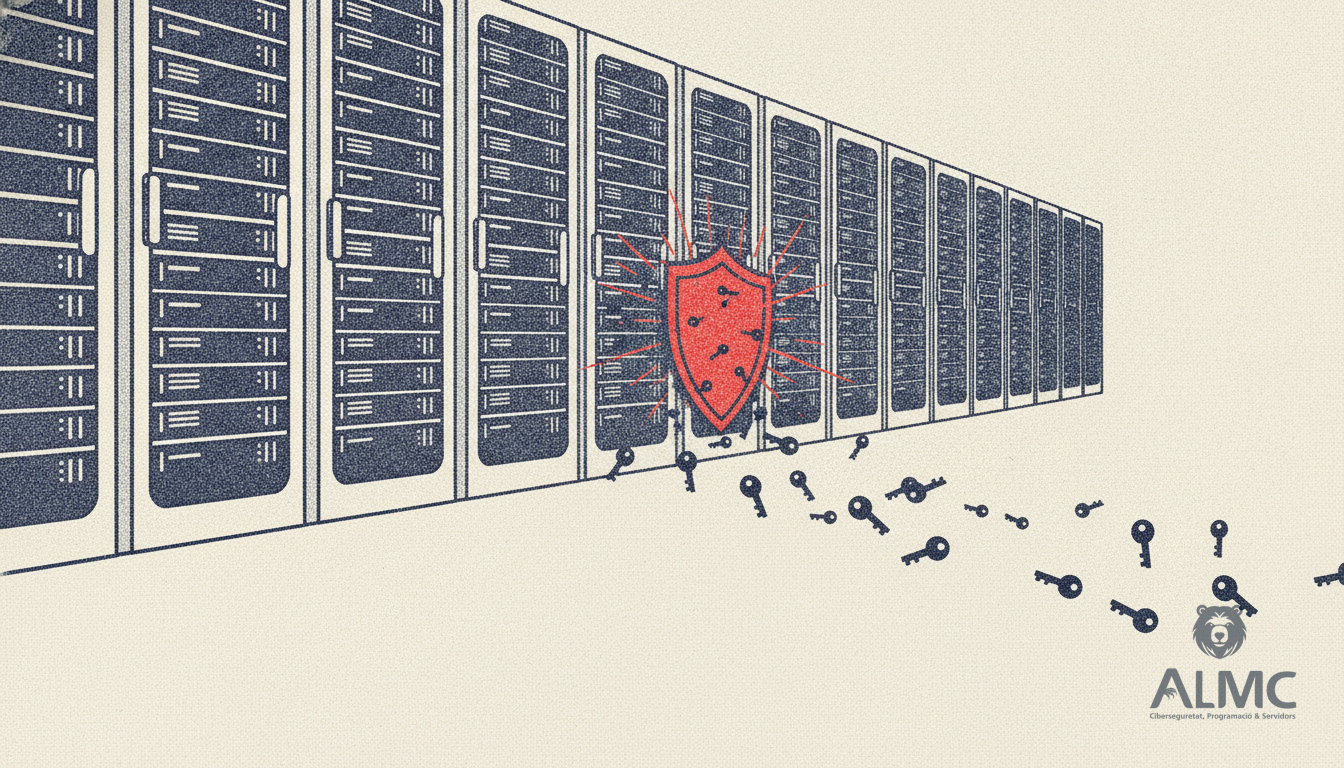
The problem is not the tooling — fail2ban is mature, well documented and effective. The problem is that protection is fragmented. Every machine learns its own lessons in isolation, and nobody shares them.
What Abuse Shield changes
Abuse Shield is our answer to that fragmentation. It is a managed service that sits across all your servers and turns isolated defences into one coordinated perimeter. Instead of configuring fail2ban by hand on each host, you get a centralised layer that does four things well:
- Automatic blocking of malicious IPs. Suspicious behaviour is detected and the offending address is blocked without waiting for a human to read a log at two in the morning.
- Managed fail2ban across multiple machines. We install, tune and maintain the jails on every server you register, so the rules stay consistent and up to date.
- A shared IP reputation feed. When one of your servers identifies an abusive address, every other server in your fleet learns about it immediately. The whole estate gets stronger with each incident.
- A single point of control. You see what is being blocked, where, and why, instead of juggling SSH sessions and scattered configuration files.
The result is a defence that compounds. A botnet probing your mail server in Girona teaches your web server in Barcelona to refuse the same source before it even tries.
Built for the people who actually run the servers
Abuse Shield is aimed at three profiles that share the same underlying pain. System administrators who are tired of maintaining the same fail2ban configuration on ten machines. Hosting companies that need a defensible, repeatable security baseline for every customer they onboard. And SMEs with their own infrastructure — an ERP, an e-commerce platform, a CRM — that cannot afford a dedicated security team but also cannot afford to be breached.
For all three, the value is the same: less time spent on repetitive hardening, fewer successful intrusions, and a clear audit trail when a client or an insurer asks what you are doing to protect their data.
Security that fits Spanish and EU compliance
Under the GDPR, a personal data breach can trigger notification obligations and, in serious cases, significant fines. Article 32 requires appropriate technical measures, and having documented, automated protection against unauthorised access is part of that picture. Abuse Shield does not replace a full compliance programme, but it gives you something concrete to point at: logs of blocked attempts, consistent rules across systems, and a reputation feed that demonstrates active monitoring.
For companies working with Catalan public administrations or larger enterprise clients, that documentation often matters as much as the protection itself.
How it fits into your existing stack
You do not need to rebuild your infrastructure to adopt it. Abuse Shield works alongside the servers you already have, whether they are dedicated machines in a Lleida data centre, cloud instances in the EU, or a hybrid mix. The managed fail2ban layer respects your existing services and does not interfere with legitimate traffic — the goal is to remove noise, not to lock out customers.
Typical deployments take a matter of hours rather than weeks, and the shared reputation feed starts delivering value from the first day, as soon as your first server reports an abusive source.
The economics of centralised protection
It is worth thinking about cost honestly. A single compromised server can mean lost revenue, emergency consultancy fees, forensic work and reputational damage that is hard to quantify. Compare that with the ongoing cost of a managed service that prevents most of those incidents from succeeding in the first place. For an SME running two or three servers, the maths usually favours centralisation quickly.
There is also a hidden cost in fragmentation: the hours your team spends repeating the same configuration work, chasing the same log lines, and manually banning the same addresses on machine after machine. Abuse Shield removes that overhead, and it does so with a setup that is maintained by people who do it every day.
Start with a conversation
If your servers currently defend themselves alone, it is worth asking what they could do together. Abuse Shield was built in Lleida for organisations that take server security seriously but do not want to build a security department to achieve it. Centralised blocking, managed fail2ban and a shared reputation feed — one perimeter instead of many isolated walls.
Related
- How to Harden Your Servers with Fail2ban and IP Reputation Feeds
- Fail2ban: Your First Line of Defense Against Unauthorized Server Access
- Critical libssh2 flaw: urgent patch for SSH servers
- Desarrollo web
Put these ideas into practice
Talk to ALMC about a solution for your business. Explore your options or contact our team.