
Blog
WP Duplicate plugin: critical RCE in versions up to 1.1.11
What it is and who is affectedCVE-2026-14492 is a remote code execution vulnerability in the WordPress plugin WP Duplicate – WordPress Migration Plugi...
What it is and who is affected
CVE-2026-14492 is a remote code execution vulnerability in the WordPress plugin WP Duplicate – WordPress Migration Plugin. According to the National Vulnerability Database (NVD) of NIST, every version up to and including 1.1.11 is affected. The flaw was published in the NVD on 19 November 2026 and carries a CVSS 3.1 score of 9.8 (CRITICAL), with the vector CVSS:3.1/AV:N/AC:L/PR:N/UI:N/S:U/C:H/I:H/A:H. It is classified as CWE-434, unrestricted upload of a file with a dangerous type.
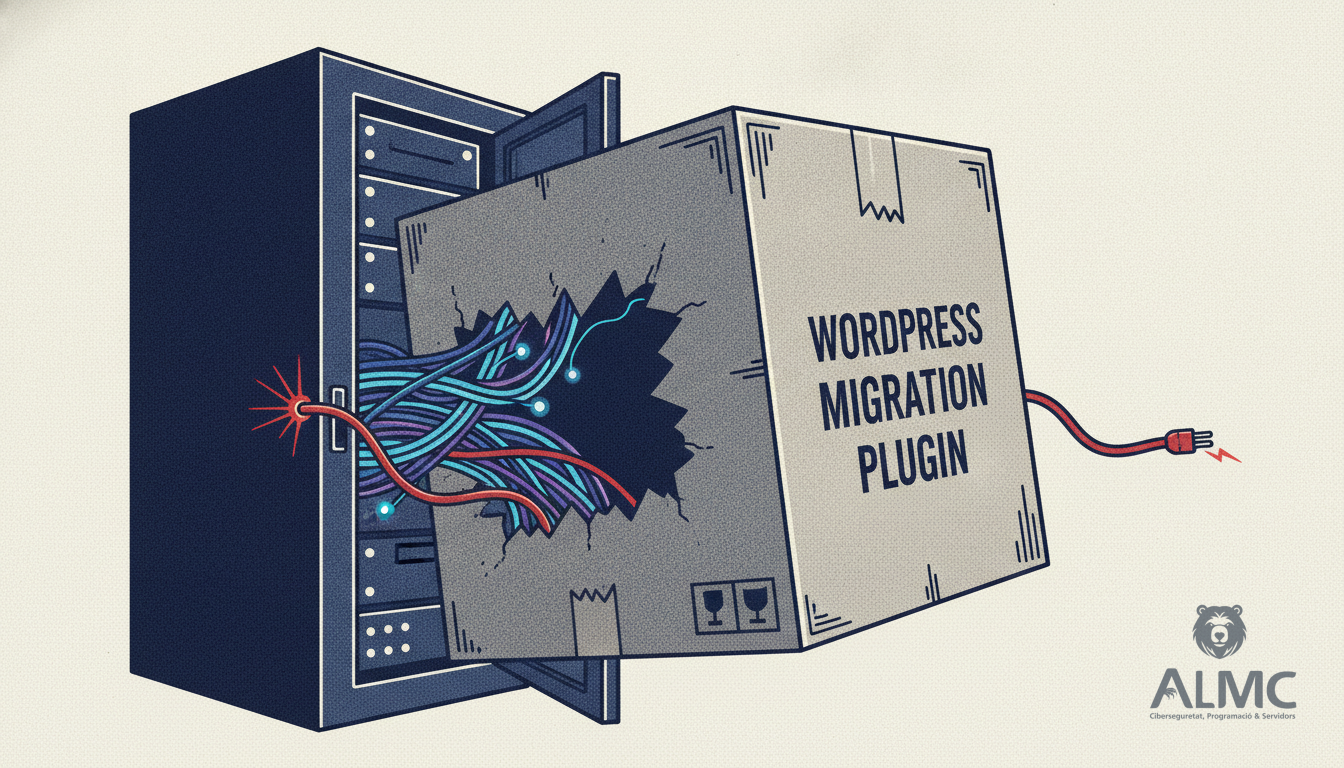
The technical root cause sits in the save_single_batch_file function. NVD describes a PHP type-juggling authentication bypass based on a loose comparison without an is_string() guard, combined with unsanitised base64-decoded path construction that lacks any directory traversal containment. In practice, this lets an authenticated attacker with custom-level access or above execute code on the server.
There is one precondition worth understanding: exploitation requires that the site owner has completed the plugin's initial setup, so that the site_type and prod_key_random_id options are non-empty. NVD also notes that any non-empty secret value can be bypassed through the type-juggling flaw, so the real exposure is not limited to sites with a strong key. Any WordPress installation running WP Duplicate at 1.1.11 or below, with the plugin configured, should be treated as in scope. That includes small businesses, online shops and agencies in Barcelona, Lleida, Tarragona or Girona that use the plugin to move or clone sites between servers.
Why it is urgent
As of the data available, CVE-2026-14492 does not appear in CISA's Known Exploited Vulnerabilities (KEV) catalogue, so there is no public record that it is being exploited in real attacks. That does not make it a low priority. A 9.8 score means the barrier to exploitation is low and the impact is full compromise of confidentiality, integrity and availability. Remote code execution on a web server is the highest tier of damage: it can lead to a hacked website, injected spam, stolen customer data, defaced pages and a server used as a stepping stone into the rest of the network.
Migration plugins are also a special case. They are designed to read, write and move files, and they are often left installed after a migration is finished. A plugin that is no longer needed but still active is exactly the kind of forgotten surface that attackers scan for. Under GDPR, a compromised site handling EU customer data also triggers notification obligations, so the cost of reacting late is measured in both euros and reputation.
What to do today
- Check whether WP Duplicate is installed and which version is running. Look in the WordPress plugin list of every site you manage, including staging and development copies, which are frequently overlooked.
- Apply the fix indicated in the vendor's security advisory. The material available does not state which version corrects the flaw, so do not assume a number: follow the plugin author's official notice and update to the version it specifies.
- If no update is available yet, deactivate and remove the plugin where it is not essential. Removing an unused migration plugin closes the exposure entirely.
- Review signs of intrusion. Check for unexpected administrator accounts, unfamiliar files in upload directories, modified core files and outbound connections you cannot explain.
- Reduce what is exposed to the internet. Restrict access to WordPress admin panels by IP where possible, enforce strong passwords and two-factor authentication, and keep a recent, tested backup stored off the server.
Remember that the flaw requires an authenticated account, so weak or shared credentials on a small site make the path shorter, not longer.
How a cybersecurity team such as ALMC's can help
Keeping track of plugin versions across a dozen WordPress, PrestaShop or Joomla sites is a job in itself, and it is usually the first thing to slip when a small IT team is busy. At ALMC we work on exactly that layer: security audits and pentesting to find vulnerabilities before someone else does, hardening of servers and CMS installations, and ongoing maintenance and updating of WordPress, PrestaShop and Joomla so that critical patches do not sit unapplied for months.
When something has already gone wrong, we also handle incident response and repair of hacked websites, including cleaning the infection, closing the entry point and restoring service from a reliable backup. For businesses in Catalonia with their own servers or a lean IT department, that combination of monitoring, patching and response is often the difference between a routine update and a very expensive week.
Related
- Ivanti Connect Secure: CVE-2026-104935 Under Active Attack
- CVE-2026-96951: Windows Shell Command Injection Under Attack
- Click to Chat for WhatsApp: CVE-2026-92097 in WordPress
- Abuse Shield
Is your business exposed to flaws like this?
ALMC checks which versions you are running, applies the patches and hardens your servers and website. Contact our team for a security review.