
Server security: why shared IP reputation beats isolated fail2ban
Server security: why shared IP reputation beats isolated fail2ban
When the threat lives inside the mail serverRecent research into long-running espionage campaigns against government networks in Europe and Central As...
When the threat lives inside the mail server
Recent research into long-running espionage campaigns against government networks in Europe and Central Asia has made one thing uncomfortably clear: the most dangerous activity on a compromised server is rarely the traffic you can see. In the cases documented, attackers had burrowed into Microsoft Exchange installations and turned the victim's own mail infrastructure into their command-and-control channel. No external hosting was needed. The server kept sending legitimate email while quietly siphoning copies of selected messages to unauthorised recipients.
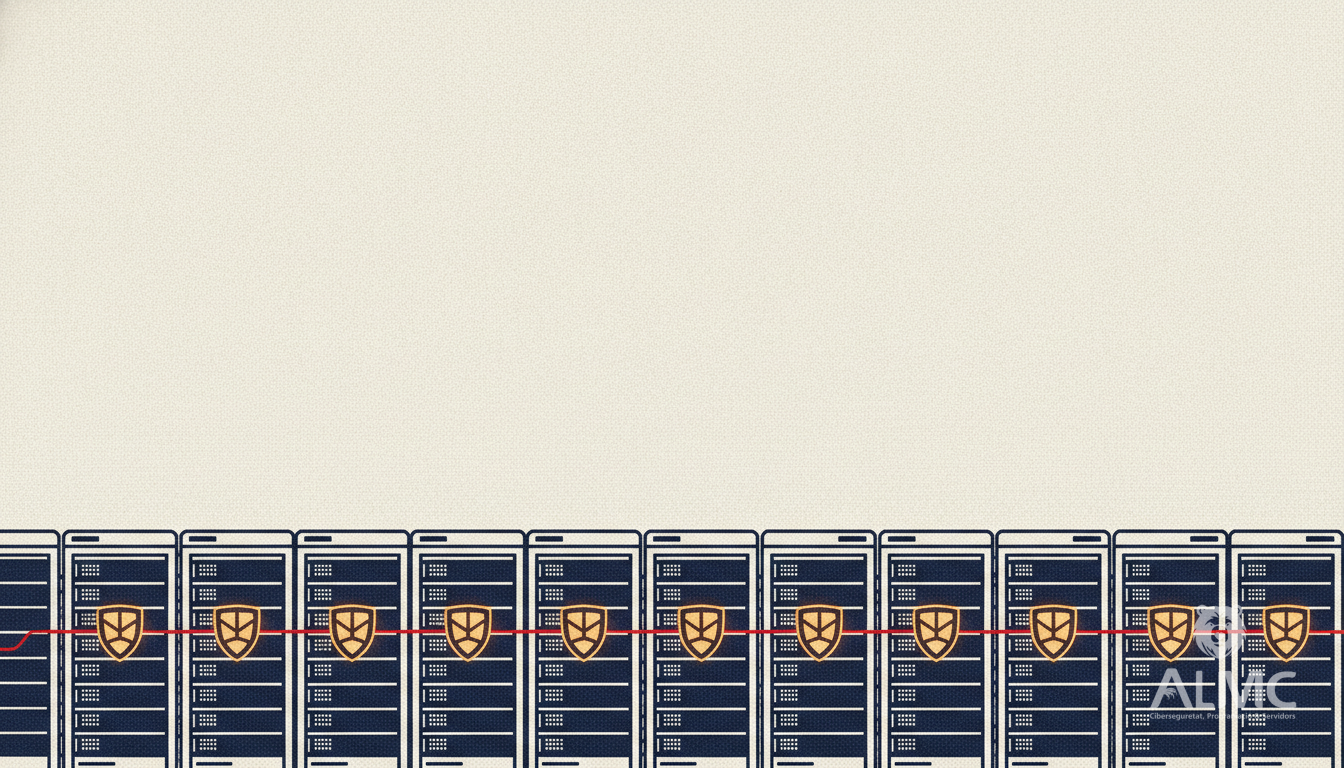
For system administrators in Barcelona, Lleida, Tarragona or Girona, the lesson is not that Exchange is uniquely broken. It is that a server is a long-lived asset with a wide attack surface, and that the gap between "the service works" and "the service is trustworthy" can stay invisible for months. Whether you run a hosting business, an SME with its own rack, or a public-facing platform, the question is the same: how do you detect and contain abuse before it becomes a data protection incident under GDPR?
Perimeter defences fail when each machine learns alone
Most teams already have something in place. A firewall, a few hardening scripts, maybe fail2ban on the busiest node. The problem is architectural rather than technical. Each server learns about abuse in isolation, from its own logs, at its own pace. An attacker who probes ten of your machines will be blocked on the first one that notices and welcomed on the other nine, because those nine have never seen that address before.
This asymmetry is exactly what automated scanning tools exploit. They rotate across address ranges, test credentials slowly, and rely on the fact that defensive knowledge does not travel between hosts. The result is predictable:
- The same malicious IP is banned repeatedly on different machines, wasting administrator time.
- Detection windows stay long because a single host only sees a fraction of the campaign.
- Rules drift between servers, so nobody can say with confidence what is actually protected.
- Incident response becomes archaeology: reconstructing what happened across inconsistent logs.
A shared reputation layer changes the economics
The alternative is to treat blocking intelligence as a common asset rather than a per-machine chore. Abuse Shield, the service we run at ALMC.es, does precisely that: it centralises protection across your fleet, manages fail2ban on multiple machines from one place, and shares an IP reputation feed between every server you enrol.
In practice this means an address that misbehaves against one host is known to all of them almost immediately. The first server to observe the abuse contributes the intelligence; the rest inherit the block without waiting to be attacked themselves. For a hosting provider with dozens of nodes, that shift alone can cut both the noise in the logs and the window of exposure.
The managed side matters just as much. fail2ban is powerful but unforgiving: jails need tuning, log paths differ between distributions, and a careless rule can lock out legitimate customers. Having the configuration maintained centrally, consistently and with visibility across machines removes a recurring operational burden from small teams that have no dedicated security staff.
Defence in depth, without pretending it is enough
It is worth being honest about scope. A reputation feed and managed banning will not stop a determined intrusion that already has valid credentials and a deep understanding of your platform, of the kind described in the Exchange research. What it does is raise the cost of the opportunistic layer that precedes almost every serious compromise: credential stuffing, brute force, vulnerability scanning and automated probing.
That layer is where most SMEs and hosting providers actually lose time and, occasionally, data. Combining shared IP reputation with the fundamentals still pays off:
- Patch internet-facing services promptly, especially mail and remote access components.
- Enforce multi-factor authentication on administrative accounts.
- Segment internal networks so a single compromised host cannot roam freely.
- Log centrally and review anomalies, not just failures.
- Keep an offline, tested backup so recovery is a procedure rather than a hope.
Built for the realities of the Catalan market
Many organisations across Catalonia run their own infrastructure precisely because they value control over their data and their GDPR obligations. That control only makes sense if security operations are sustainable with the team you actually have. Centralising IP blocking and reputation across servers turns a set of disconnected, best-effort defences into a coherent posture you can explain to a client, an auditor or a board.
If your servers currently defend themselves one by one, it is worth asking how much an attacker already knows about the ones that have not noticed yet.
Related
- How to Harden Your Servers with Fail2ban and IP Reputation Feeds
- Fail2ban: Your First Line of Defense Against Unauthorized Server Access
- Critical libssh2 flaw: urgent patch for SSH servers
- Desarrollo web
Put these ideas into practice
Talk to ALMC about a solution for your business. Explore your options or contact our team.