
Session hijacking: why your server needs more than strong passwords
Session hijacking: why your server needs more than strong passwords
The uncomfortable truth about stolen sessionsMost security advice still revolves around two pillars: use a strong password and switch on two-factor au...
The uncomfortable truth about stolen sessions
Most security advice still revolves around two pillars: use a strong password and switch on two-factor authentication. Both matter, and neither is optional. But a recent incident involving a well-known AI assistant showed how easily that logic breaks down when the endpoint itself is compromised. An infostealer — malware designed to quietly harvest credentials, browser cookies and session tokens — grabbed already-authenticated sessions and reused them to run up charges on user accounts. Two-factor authentication was active in at least one reported case, and it made no difference: the attacker never needed to log in, because the session was already logged in for them.
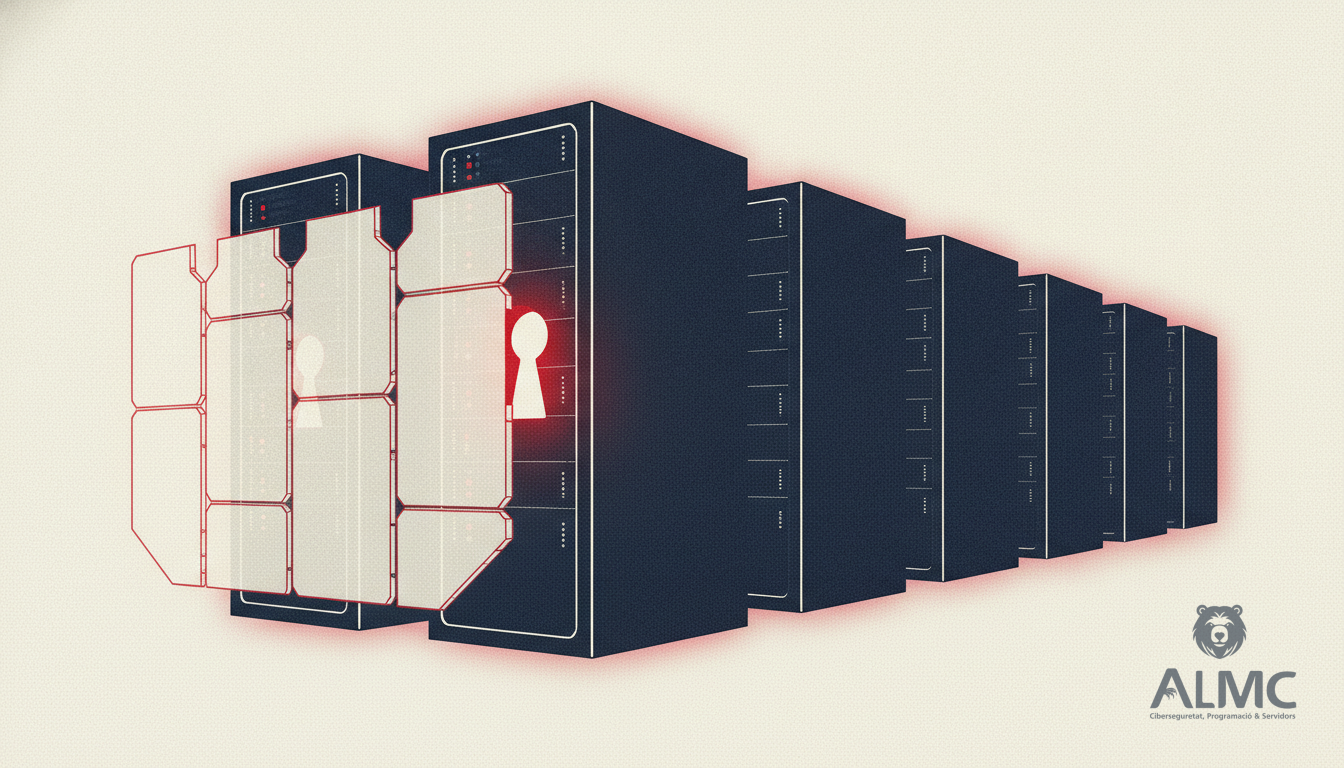
The provider reacted quickly, cutting off the affected sessions, removing stored payment methods and reimbursing the charges it could identify as fraudulent. It also stressed that the root cause sat on infected computers, not on the platform. That distinction is fair, but it is also the part most organisations overlook. If a workstation is compromised, no amount of login hardening protects the accounts that workstation touches.
What this means for anyone running servers
Translate the story to a business context in Catalonia and the stakes rise. A small company in Lleida with its own server, or a hosting provider in Barcelona managing dozens of machines for clients, does not only worry about one user's subscription credits. It worries about the credentials, API keys, database access and control panels that live on those machines. Infostealers such as Vidar, Lumma, StealC, RedLine and Atomic Stealer are commodity tools now, distributed through pirated software, cracked installers and convincing phishing pages. They do not need zero-days. They need one careless download.
The lesson is not "abandon 2FA". It is that endpoint hygiene and network-level defence have to work together. Strong authentication protects the front door; it does nothing when someone walks out with the keys to a room that is already unlocked.
Where perimeter defence actually earns its keep
This is the gap that server-side protection fills. When a compromised laptop starts probing your infrastructure — trying SSH passwords, hammering a login form, scraping endpoints or scanning for exposed services — the fastest useful response is to stop talking to that IP address. Not tomorrow, not after a ticket is reviewed: now.
Fail2ban has done this job for years, and it remains a solid tool. The problem is scale and consistency. Ten servers mean ten separate configurations, ten sets of logs to watch and ten chances for one machine to be missed during a rollout. An attacker blocked on the web server in Girona is often still free to try the mail server in Tarragona, because nobody told it what the other machine had learned.
That is precisely the gap Abuse Shield is built to close:
- Automatic IP blocking across your machines, so a hostile address is cut off the moment it misbehaves rather than after a manual review.
- Managed fail2ban on multiple machines, configured and kept consistent from one place instead of drifting server by server.
- A shared reputation feed between all your servers: what one machine detects, every machine knows, so an attacker cannot simply rotate to a sibling host.
For a hosting company this is close to essential. For a pyme running its own infrastructure, it turns a task nobody has time for into a baseline that maintains itself.
Building a realistic defence in depth
No single control stops an infostealer, and it would be dishonest to suggest otherwise. What works is stacking measures so that each one covers the blind spot of the next:
- Keep operating systems, panels and CMS installations patched, and remove software nobody uses.
- Ban pirated and unverified downloads on work machines; most commodity stealers arrive that way.
- Rotate credentials and revoke active sessions after any suspected infection, not just the password.
- Watch for unusual login locations and unexpected consumption of paid resources.
- Apply network-level blocking so compromised hosts lose their foothold quickly.
- Document an incident routine that complies with GDPR notification duties if personal data is exposed.
Budget matters here. A serious breach — downtime, forensic work, lost client trust, possible GDPR exposure — easily costs a Catalan pyme tens of thousands of euros. A managed protection layer is a rounding error next to that figure, and it frees your team to work on the projects that actually generate revenue.
The takeaway
Stolen sessions are a reminder that security is only as strong as its weakest layer. Passwords and 2FA remain necessary, but they cannot compensate for an infected device or an unguarded server. Centralising IP blocking, fail2ban management and reputation sharing across your fleet gives you something the attacker cannot easily route around: a perimeter that learns. If your servers are still defended one machine at a time, that is the place to start.
Related
- How to Harden Your Servers with Fail2ban and IP Reputation Feeds
- Fail2ban: Your First Line of Defense Against Unauthorized Server Access
- Critical libssh2 flaw: urgent patch for SSH servers
- Desarrollo web
Put these ideas into practice
Talk to ALMC about a solution for your business. Explore your options or contact our team.