
Server Security: Why Shared IP Reputation Beats Isolated Firewalls
Server Security: Why Shared IP Reputation Beats Isolated Firewalls
The threat landscape has shifted towards persistent, targeted intrusionRecent threat intelligence covering the second half of 2026 paints a picture th...
The threat landscape has shifted towards persistent, targeted intrusion
Recent threat intelligence covering the second half of 2026 paints a picture that should concern anyone running infrastructure in Catalonia and across Spain. State-aligned groups are no longer opportunistic: they run long-term intelligence-gathering operations against government bodies, semiconductor supply chains, telecoms and data providers. Activity aligned with Iran and North Korea has picked up again after quieter periods, and several of these actors have refreshed their toolkits, which suggests renewed investment in development. For a small or mid-sized organisation, the uncomfortable conclusion is simple: the attacks that used to be reserved for large enterprises now reach ordinary servers, often through the same unpatched service or weak credential.
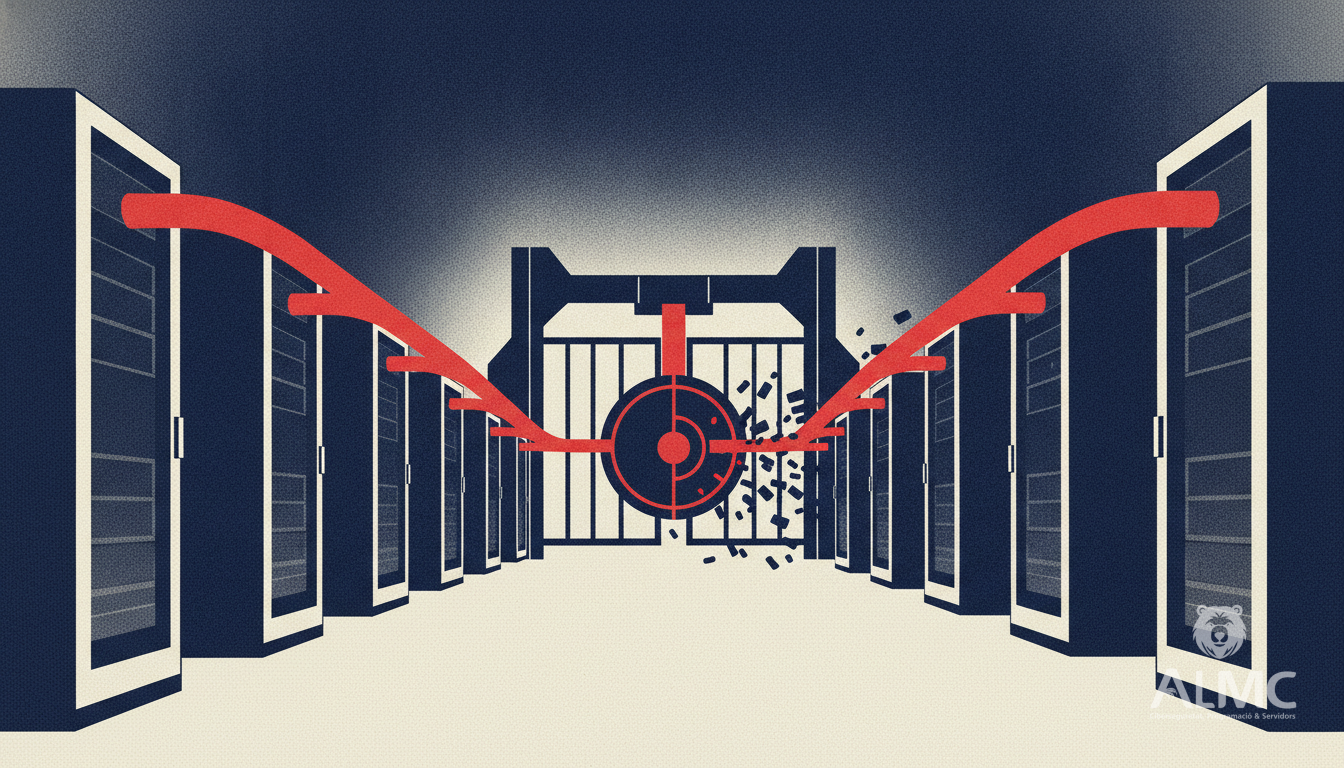
At the same time, most SMEs and hosting providers still defend each machine in isolation. One firewall here, one manual block there, a log file nobody reads until something breaks. That model collapses the moment you run more than a handful of servers.
Why per-server blocking does not scale
Traditional intrusion prevention works on a single host: it watches authentication logs, detects repeated failures and bans the offending address. The logic is sound, but the economics are poor. If you operate five, twenty or fifty machines, an attacker who is banned on one server is free to try the next. Each host learns the same lesson from scratch, and your team repeats the same triage over and over.
- Duplicated effort: every server maintains its own ban list, and nobody aggregates them.
- Slow reaction: an address hammering your SSH or mail service on Monday may only be blocked on Wednesday.
- Inconsistent rules: different administrators configure different thresholds, so protection varies by machine.
- No institutional memory: when a server is rebuilt, its history of abuse disappears with it.
This is precisely the gap that a centralised approach closes. Instead of treating each server as an island, you treat your fleet as a single defensive organism.
What Abuse Shield changes in practice
Abuse Shield, the service we run at ALMC, brings three capabilities together. First, it automates the blocking of malicious IP addresses, so repeated failed logins, abusive crawling and brute-force patterns are handled without waiting for a human. Second, it manages fail2ban across multiple machines from one place, which means consistent thresholds and one dashboard instead of a dozen terminals. Third, and most importantly, it operates a shared reputation feed: when one of your servers identifies a hostile address, every other server in your estate learns about it immediately.
The effect compounds. A botnet that probes your Barcelona front-end at 03:00 is already blocked on your Lleida database server and your Tarragona mail relay before it tries them. The cost of defence stops growing linearly with the number of machines.
Built for GDPR-conscious operations
Any security tool that processes connection data touches personal data under the GDPR, and Spanish organisations are rightly careful about this. Abuse Shield works with IP addresses and connection metadata rather than content, and the reputation feed is designed to share indicators of abuse, not customer records. That keeps your processing minimal and your records of processing activities straightforward, which matters when a client in Girona or an auditor asks how you handle logs.
Who benefits most
Hosting companies feel the pain most acutely, because a single compromised tenant can damage the reputation of an entire IP range. System administrators managing mixed estates appreciate the single point of control. And SMEs that have grown from one server to a small cluster usually discover, too late, that their protection never grew with them. If any of that sounds familiar, centralising your defences is a smaller project than you might expect, and it pays back the first time an attack is stopped fleet-wide instead of host by host.
Related
- How to Harden Your Servers with Fail2ban and IP Reputation Feeds
- Fail2ban: Your First Line of Defense Against Unauthorized Server Access
- Critical libssh2 flaw: urgent patch for SSH servers
- Desarrollo web
Put these ideas into practice
Talk to ALMC about a solution for your business. Explore your options or contact our team.