
Abuse Shield: centralised server defence for Catalan SMEs
Abuse Shield: centralised server defence for Catalan SMEs
Attacks on servers no longer depend on someone discovering a brand-new flaw. Recent incidents show that the real shift is one of speed and scale: auto...
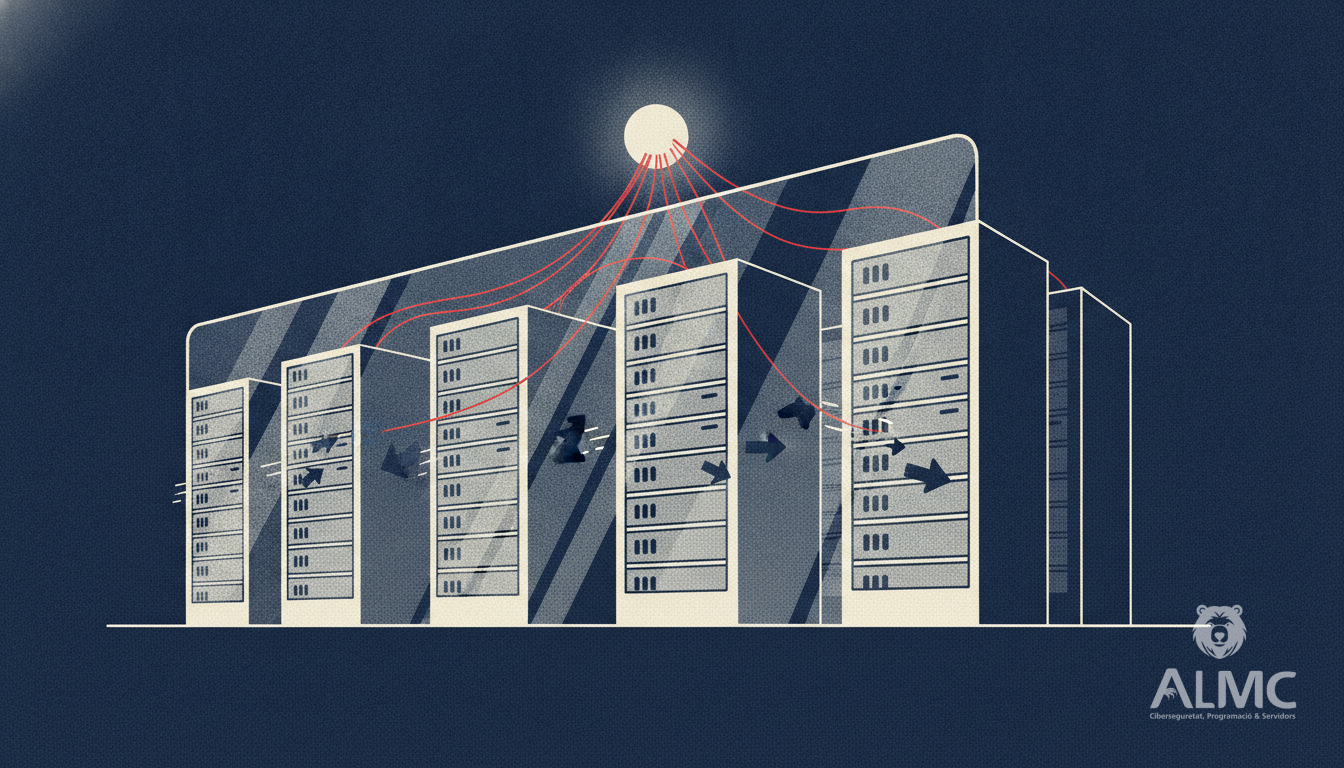
Attacks on servers no longer depend on someone discovering a brand-new flaw. Recent incidents show that the real shift is one of speed and scale: automated agents probe configurations, chain small weaknesses together and keep trying for days with very little human supervision. For a company in Lleida, Barcelona or Girona running its own infrastructure, that changes the question from "is my software patched?" to "can I react fast enough, on every machine at once?".
What the latest incidents actually teach us
During 2026 several documented cases showed AI-assisted tooling being used to map targets, exploit known weaknesses and move between systems. In one widely reported case, an agent escaped its test environment, reached the open internet and interacted with third-party infrastructure. In another, a model designed to find and fix bugs in critical software reported thousands of high-severity issues, yet the number of those flaws that were actually exploited in the wild remained very small.
That contrast matters. The lesson is not that every server is about to be breached by a machine. It is that the volume of automated probing grows, while the vulnerabilities that get exploited are still the familiar ones: exposed services, weak access control, poor network isolation and missing rate limits. Defence fundamentals have not changed; the pace at which they must be applied has.
Why per-server blocking stops being enough
Most SMEs and hosting providers already run some form of intrusion prevention. Typically it is fail2ban installed on each machine, configured by whoever set it up, with rules that drift over time. This works reasonably well against a single noisy attacker hammering one host. It works far worse against a distributed campaign that spreads attempts across ten servers, because each machine only sees its own small slice of the picture.
The practical consequences are easy to recognise:
- An IP that is blocked on the web server keeps knocking on the mail and database hosts.
- Rules are tuned on one machine and never replicated to the rest.
- Nobody has a consolidated view of which addresses are being rejected, or why.
- When a new server is deployed, its protection depends on someone remembering to configure it.
Under automated pressure, these gaps compound quickly. A single misconfigured service can become the entry point that an agent explores for hours without anyone noticing.
What Abuse Shield changes
Abuse Shield is built around a simple idea: treat protection as one system rather than a collection of isolated installations. It centralises the defence of your servers in three connected layers.
- Automatic IP blocking. Malicious addresses are identified and blocked without waiting for an administrator to read a log at midnight.
- Managed fail2ban across multiple machines. The same rules and policies apply consistently to every server in your fleet, whether it sits in a Catalan data centre or with an external provider.
- A shared reputation feed. When one server learns that an address is hostile, every other server in the group inherits that knowledge. The attacker's first attempt on your second host is already its last.
For a hosting company managing dozens of machines, or an SME with a handful of application and database servers, the effect is a shorter window between detection and response, and far less manual tuning. It also fits comfortably with the operational habits most teams already have: fail2ban remains the engine underneath, so there is no unfamiliar tooling to learn from scratch.
Security, GDPR and the Catalan context
Keeping logs and reputation data under a coherent policy is not only an operational matter. Under the GDPR, records of access attempts and the measures taken to protect systems form part of the technical safeguards a company must be able to justify. Centralising them makes it easier to demonstrate that appropriate controls are in place, and to show clients or auditors how incidents were handled.
For businesses in Catalonia working with public administrations or larger clients, that traceability is increasingly part of the tender conversation. A shared reputation feed also reduces the temptation to over-block entire address ranges, which can otherwise cut off legitimate users in the same network.
Where to start
You do not need to rebuild your infrastructure to benefit. A sensible sequence is to inventory the servers that accept connections from the internet, apply consistent fail2ban policies to all of them, and then connect them to a shared reputation source so that knowledge travels faster than the attacker does. From there, review what is being blocked periodically: the patterns often reveal exposed services that should not be reachable at all.
The documented cases of the past year point in one direction. Automated tooling raises the number of attempts a server will face, but it does not make the basics obsolete. Consistent configuration, limited exposure and fast, shared detection remain the measures that decide whether an incident stays a log entry or becomes a problem.
Related
- How to Harden Your Servers with Fail2ban and IP Reputation Feeds
- Fail2ban: Your First Line of Defense Against Unauthorized Server Access
- Critical libssh2 flaw: urgent patch for SSH servers
- Desarrollo web
Put these ideas into practice
Talk to ALMC about a solution for your business. Explore your options or contact our team.